1

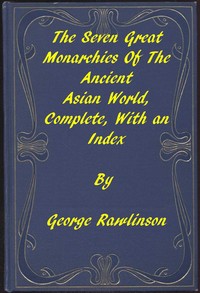
The Seven Great Monarchies of the Ancient Asian World A Linked Index to the Project Gutenberg Editions — Background and Themes
(0 User reviews)
94
Project Gutenberg
2009
Not confirmed
History, Ancient; Babylonia -- History; Indexes; Assyria -- History; Parthia -- History; Iran -- History
Readers of public-domain and historical texts
Project Gutenberg digital edition
en
Edition facts
Words
4,538
Reading time
20 min
Text sections
2
For The Seven Great Monarchies of the Ancient Asian World A Linked Index to the Project Gutenberg Editions — Background and Themes, the stored edition analysis reports 4,538 words, 20 min estimated reading time, and 2 detected text sections.
The text analysis averages about 18.4 words per sentence, while the detected sections provide another way to judge how the source is divided.
Project Gutenberg metadata also associates the work with “History, Ancient,” connecting these edition facts with the source record’s subject description.
Source:
Project Gutenberg record #28871
A linked index to George Rawlinson's seven-volume history of ancient Asian empires, edited by David Widger, providing chapter-by-chapter navigation and illustration lists for Chaldaea, Assyria, Media, Babylon, Persia, Parthia, and the Sassanian Empire, plus Phoenicia.
Read the complete public-domain text at its original source.
Read on Project GutenbergRawlinson's The Seven Great Monarchies is a work of Victorian scholarship that methodically surveys the ancient empires of Western Asia. The author's prose is deliberate and descriptive, often opening chapters with geographical overviews before turning to climate, people, language, arts, and chronology. In the Chaldaea section, for instance, he devotes separate chapters to each of these facets, signaling a systematic approach that prioritizes classification over narrative.
Editor David Widger has transformed this multi-volume set into a single indexed HTML file, linking each chapter and illustration to the original Project Gutenberg texts. The result is a navigational tool rather than a reading edition: the index lists contents for seven monarchies plus a history of Phoenicia, with plate references such as "Plan of Mugheir ruins (after Taylor)" and "Chaldaean reeds, from an Assyrian sculpture (after Layard)." This structure reveals Rawlinson's reliance on contemporary archaeological illustrations and his habit of crediting sources like Loftus, Ker Porter, and Oppert.
A Victorian Scholar's Architecture
Rawlinson's organizational scheme is evident from the table of contents. Each monarchy receives a uniform set of chapter headings: General View of the Country, Climate and Productions, The People, Language and Writing, Arts and Sciences, Manners and Customs, Religion, and History and Chronology. This template-like structure suggests that Rawlinson saw these empires as comparable units, each to be analyzed through the same lens. The repetition of categories across volumes—Chaldaea, Assyria, Media, Babylon, Persia, Parthia, Sassanian Empire—creates a predictable rhythm that aids cross-referencing but also imposes a rigid framework on diverse cultures.
The editor's index preserves this architecture, listing every chapter title verbatim. For example, under "Chaldaea" the user finds "CHAPTER I. GENERAL VIEW OF THE COUNTRY" followed by "CHAPTER II. CLIMATE AND PRODUCTIONS," and so on. This fidelity to the original structure means the index functions as a map of Rawlinson's method: a systematic, almost encyclopedic treatment that values completeness over narrative flow.
Illustrations as Evidence
The index includes a detailed list of illustrations for each monarchy, revealing Rawlinson's use of visual evidence. Plate descriptions name the source of each image: "Plan of Mugheir ruins (after Taylor)," "Ruins of Warka (Erech) (after Loftus)," "Akkerkuf (after Ker Porter)." These attributions indicate that Rawlinson drew on the work of nineteenth-century explorers and archaeologists, incorporating their drawings and plans into his text. The plates themselves cover a range of subjects—ruins, artifacts, inscriptions, even "Chaldaean reeds, from an Assyrian sculpture (after Layard)" and "Wild sow and pigs, from Koyunjik (Layard)."
This reliance on contemporary fieldwork gives the work a documentary quality. Rawlinson does not merely describe; he points to specific visual records, grounding his claims in material remains. The editor's index makes these references clickable, linking each plate to its location in the full text. For readers interested in the history of archaeology, the illustration list offers a snapshot of which sites and objects were considered significant in the 1860s–1870s.
The Editor's Role: Linking, Not Rewriting
David Widger's editorial contribution is primarily structural. He has compiled the contents of multiple Project Gutenberg ebooks—the seven monarchies plus the history of Phoenicia—into a single index file. The index does not abridge or annotate Rawlinson's text; it provides hyperlinks to the original volumes. For instance, clicking on "## Chaldaea" leads to a linked index of that volume's chapters and illustrations. The editor also notes that mobile viewers (Kindle, Nook) will automatically list titles, so no separate index is provided for .mobi or .epub files.
This approach prioritizes access over interpretation. The index is a finding aid, not a critical edition. Widger's own voice appears only in the brief instructions for downloading and in the standard Project Gutenberg boilerplate. The result is a tool that lets readers navigate Rawlinson's sprawling work without editorial commentary—a neutral gateway to the original Victorian scholarship.
Diction and the Scholarly Persona
Even from the limited excerpts, Rawlinson's diction signals his scholarly persona. He uses formal, Latinate vocabulary and complex sentence structures typical of Victorian academic prose. Phrases like "GENERAL VIEW OF THE COUNTRY" and "CLIMATE AND PRODUCTIONS" reflect a taxonomic impulse. The prefaces—"PREFACE TO FIVE GREAT MONARCHIES," "PREFACE TO SECOND EDITION," "PREFACE TO THE SIXTH MONARCHY," "PREFACE TO SEVENTH MONARCHY"—suggest that the work grew incrementally, with each monarchy published separately before being collected.
Rawlinson also employs a first-person plural in his illustration credits: "drawn by the Author, from bricks in the British Museum" and "restored by the Author." This personal involvement in creating visual reconstructions (e.g., "Mugheir Temple, restored (by the Author)") indicates that he did not merely compile others' findings but actively interpreted archaeological data. The index preserves these small authorial markers, reminding readers that Rawlinson was both historian and illustrator.
This index is best used as a companion while reading the full text of Rawlinson's monarchies. Because it lists every chapter and illustration, it allows quick navigation to specific topics—say, Chaldaean religion or Assyrian arts. Readers interested in the development of ancient historiography may also find it useful to compare the chapter structures across monarchies, noting where Rawlinson deviates from his template. The editor has provided a clean, functional tool; the substance remains Rawlinson's.
I keep coming back to that linked index of Rawlinson’s monarchies, how it maps the long shadows of Chaldaea and Parthia. It stirs the same slow wonder I felt once with History of Egypt, Chaldæa, Syria, Babylonia, and Assyria, Volume 2 (of 12) — Key Ideas to Explore—that quiet sense of standing beside a very old river, watching empires rise like weather.
There are no reviews for this eBook.
There are no comments for this eBook.
Reader reflection
Before you leave, reflect on the book
Use these questions to collect your thoughts before moving on.
Your progress
0
/
10
2
Was reading this book enjoyable?
3
How likely are you to recommend this book?
4
How easy was the book to follow?
5
Did the book deliver what you hoped for?
6
Could you apply anything you learned?
7
Was the book moving at the right speed?
8
Is this a title worth rereading?
9
In one sentence, what did you learn?
10