1

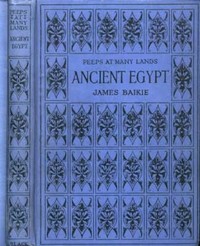
Peeps at Many Lands: Ancient Egypt — Themes and Context
(0 User reviews)
343
Project Gutenberg
2007
Not confirmed
Egypt -- History, Ancient; Egypt -- Social life and customs
Readers of public-domain and historical texts
Project Gutenberg digital edition
en
Edition facts
Words
30,291
Reading time
132 min
Text sections
4
The catalog record for Peeps at Many Lands: Ancient Egypt — Themes and Context provides practical reading context through 30,291 words, 2 hr 12 min estimated reading time, and 4 detected text sections.
The text analysis averages about 27.7 words per sentence, while the detected sections provide another way to judge how the source is divided.
Project Gutenberg metadata also associates the work with “Egypt -- History, Ancient,” connecting these edition facts with the source record’s subject description.
Source:
Project Gutenberg record #22799
Examines James Baikie's 1912 children's book on ancient Egypt, focusing on his conversational tone, use of embedded fairy tales, and descriptive choices that blend historical overview with storytelling.
Read the complete public-domain text at its original source.
Read on Project GutenbergJames Baikie opens Peeps at Many Lands: Ancient Egypt with a direct address to his young readers, comparing Egypt's interest to Palestine's and grounding his authority in biblical stories. His prose is informal and explanatory, using phrases like 'I suppose that most people would say' to create a shared inquiry. The book's structure alternates between historical chapters—such as 'A Day in Thebes' and 'Pharaoh at Home'—and retellings of ancient Egyptian fairy tales, including the Shipwrecked Sailor and the Doomed Prince. Baikie's voice is that of a knowledgeable guide, not a detached scholar, and he frequently draws analogies to familiar concepts, like comparing Mesopotamia to 'America to the men of Queen Elizabeth's time.'
Conversational Authority and Biblical Framing
Baikie establishes his credibility through a familiar, almost paternal tone. He begins by ranking Egypt second only to Palestine in interest, a move that both flatters his audience's likely knowledge and anchors his subject in the Bible. Phrases like 'all those beautiful stories of the Old Testament' and references to Joseph and Moses serve as cultural touchstones. This framing is not merely introductory; it recurs in later chapters, where he compares Egyptian exploration to 'the heart of Africa to your grandfathers.' The author assumes a shared cultural and religious background with his readers, using it to bridge the ancient and the modern. His diction is consistently accessible: 'wonderful,' 'strange,' 'brave soldiers,' and 'wise men' populate his descriptions, avoiding academic jargon in favor of evocative simplicity.
Embedded Fairy Tales as Historical Evidence
Two of the book's thirteen chapters are devoted to retelling ancient Egyptian stories, which Baikie presents as both entertainment and historical artifacts. The Shipwrecked Sailor narrative is rendered in first-person dialogue, with the serpent character speaking in a formal, almost regal tone: 'Thou hast nothing that I need, for I am Prince of the Land of Punt.' Baikie preserves the story's structure—a voyage, a magical island, a prophecy—while adding explanatory asides. In the Doomed Prince tale, he notes that 'some of our own fairy-stories have been made out of very much the same materials,' drawing a direct line between Egyptian motifs and European folklore. These retellings are not footnoted or analyzed; instead, they are woven into the historical narrative as examples of Egyptian imagination and literary tradition.
Descriptive Economy in Setting and Detail
Baikie's descriptive passages are concise, often relying on a single vivid detail to evoke a scene. In 'A Day in Thebes,' he mentions 'the great gate of the Temple of Luxor, with obelisk' and 'the bark of the moon, guarded by the divine eyes,' but does not linger on architectural minutiae. His illustrations, many in color by Constance N. Baikie, complement this approach: plates such as 'An Egyptian Galley, 1500 B.C.' and 'Ramses II in His War-Chariot' provide visual anchors. The text itself prioritizes action and human interest over exhaustive description. For example, the story of Zazamankh and the lost coronet is summarized in a single plate caption, implying that the image carries the descriptive weight. This economy suggests Baikie trusts his young readers to infer grandeur from a few well-chosen words and pictures.
Temporal Shifts and the Reader's Imagination
Baikie frequently moves between historical periods, using temporal leaps to maintain narrative momentum. He jumps from the Old Kingdom fairy tales to the empire of 1500 BC, noting that 'Mesopotamia, or Naharaina, as the Egyptians called it, had been an unknown land to them before this time.' These shifts are marked by phrases like 'our last story belongs to a later age' or 'now, behold! when the time was come,' which mimic oral storytelling. The author also invites readers to imagine themselves in ancient settings: 'If we were asked to name the most interesting country in the world' or 'thou shalt dwell for four months in this isle.' This direct address collapses the distance between reader and subject, making history feel immediate. Baikie's choices in pacing and perspective prioritize engagement over chronological rigor.
The Role of the Illustrator in Shaping Perception
Constance N. Baikie's sixteen full-page illustrations, eight in color, are integral to the book's method. Plates like 'The Goddess Isis Dandling the King' and 'An Egyptian Country House' offer romanticized, picturesque views that align with Baikie's textual tone. The captions often summarize or highlight key moments: 'And the goose stood up and cackled' from the fairy-tale section, or 'A desert postman' from the exploration chapter. These images do not merely decorate; they provide visual evidence for Baikie's claims about Egyptian life and art. The collaboration between text and image is tight—the frontispiece, 'An Egyptian Galley, 1500 B.C.,' sets the maritime theme that recurs in the Shipwrecked Sailor story. Together, they create a cohesive, curated vision of ancient Egypt that is both informative and aesthetically consistent.
Baikie's Peeps at Many Lands: Ancient Egypt is best approached as a period piece of Edwardian children's non-fiction, where authority is conveyed through a friendly, moralizing voice and history is made palatable through story and picture. Readers interested in the construction of popular historical narratives will find rich material in Baikie's choices of what to include—and what to omit. The book rewards attention to its rhetorical strategies: the biblical framing, the embedded tales, and the selective use of detail all serve to create a vivid but partial portrait of a civilization.
Baikie’s gentle voice, slipping fairy tales between the dust and monuments, reminded me of my father reading aloud by lamplight, his finger tracing the Nile’s bend. That same unhurried wonder surfaced years later in History of Egypt, Chaldæa, Syria, Babylonia, and Assyria, Volume 5 (of 12) — Edition Insights, where old gods seemed to pause, listening. Both books left me staring at the ceiling, hearing faint drums.
There are no reviews for this eBook.
There are no comments for this eBook.
Reader reflection
What did you think of this book?
Answer a few questions and save a private reflection on this device.
Your progress
0
/
10
2
Was reading this book enjoyable?
3
Is this a title you would suggest to others?
4
How easy was the book to follow?
5
How original did the book feel?
6
Did the book give you something worth debating?
7
What was its emotional impact?
8
Which part made the strongest impression?
9
What is the main idea you are taking away?
10