1

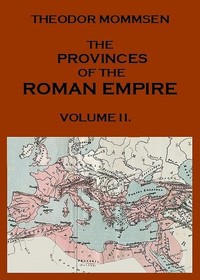
The Provinces of the Roman Empire, from Caesar to Diocletian. v. 2 — A Closer Reading
(0 User reviews)
536
Project Gutenberg
2015
Not confirmed
Rome -- History -- Empire, 30 B.C.-476 A.D.; Roman provinces -- Administration
Readers of public-domain and historical texts
Project Gutenberg digital edition
en
Edition facts
Words
153,917
Reading time
670 min
Text sections
18
Before opening The Provinces of the Roman Empire, from Caesar to Diocletian. v. 2 — A Closer Reading, the edition data offers a quick orientation: 153,917 words, 11 hr 10 min estimated reading time, and 18 detected text sections.
The text analysis averages about 23.0 words per sentence, while the detected sections provide another way to judge how the source is divided.
Project Gutenberg metadata also associates the work with “Rome -- History -- Empire, 30 B.C.-476 A.D.,” connecting these edition facts with the source record’s subject description.
Source:
Project Gutenberg record #49483
Mommsen's comparative analysis of Syrian and Egyptian provincial life, contrasting Antiochene and Alexandrian civic character through specific episodes like chariot-race violence and religious syncretism, while tracing the Euphrates frontier's role in imperial strategy.
Read the complete public-domain text at its original source.
Read on Project GutenbergTheodor Mommsen opens his survey of the Roman East by situating the empire of Iran as the only great state bordering Rome, grounding his analysis in the Achaemenid legacy and the religious unity of Ahura Mazda worship. This geopolitical framing sets the stage for a detailed examination of provincial administration along the Euphrates frontier, where Roman and Parthian spheres collided.
Mommsen’s method is comparative: he juxtaposes Syrian Antioch and Egyptian Alexandria not merely as administrative centers but as distinct civic organisms. His evidence is drawn from specific incidents—a chariot-race riot in Alexandria that ended in stabbings, contrasted with an Antiochene disturbance quelled by a single official warning—revealing how local character shaped imperial governance.
Civic Temperament in Antioch and Alexandria
Mommsen draws a sharp distinction between the two great Hellenistic cities of the East. In Antioch, he notes, an earnest word from the authorities sufficed to end a Jewish persecution under Gaius, while in Alexandria the same crisis cost thousands of lives. The Alexandrian populace, he reports, would not rest until they saw blood after a riot. A fourth-century observer quoted by Mommsen claims governors entered Alexandria “with trembling and despair,” fearing arson and stoning if they erred. The author does not endorse this lynch-system but presents it as a dishonor to both government and nation. He extends the pattern into church history, citing the murders of Bishop Georgius and the philosopher Hypatia as continuations of the same civic violence. These are not abstract generalizations; Mommsen anchors them in named events and named victims.
Religious Syncretism and Its Limits
Both cities Hellenized indigenous cults, but Mommsen traces different trajectories. In Syria, Belus and Elagabalus were adapted into Greco-Roman forms; in Egypt, the Ptolemies introduced Sarapis—a fusion of Pluto with Osiris—while preserving the older Isis worship. Mommsen notes that the immorality associated with religious festivals was comparable in both cities, yet Egypt remained the stronghold of traditional cultus into late antiquity. He identifies Alexandria as the center of philosophical paganism and the revival of temple worship against Christianity, but also as the cradle of monachism once the new faith prevailed. This observation ties religious practice to enduring regional character: Syria gave birth to Christianity, Egypt to monasticism. The Jewish diaspora, liable to poll-tax like Egyptians yet distinct from Hellenes, forms a third element in both cities, though Mommsen refers readers to an earlier chapter for fuller treatment.
Narrative Pace and Shifts in Scale
Mommsen’s prose moves between sweeping geopolitical overview and granular anecdote. The chapter on the Euphrates frontier begins with the ancient Iranian empire’s boundaries—from the Indian Ocean to the Caspian, from the steppes of Turan to the mountains separating Persia from India—then narrows to the specific friction points along the Tigris and Euphrates. This shift in scale is characteristic: a paragraph on the Achaemenid consolidation of Iranian tribes gives way to a discussion of Roman military outposts. Later, in the comparison of Antioch and Alexandria, the scale contracts further to individual riots and official responses. Mommsen uses these shifts to illustrate how imperial structures were tested by local conditions. The reader should attend to these transitions, as they reveal the author’s argument that provincial character was not merely a footnote to imperial history but a force that shaped policy and daily administration.
Readers approaching this volume will benefit from tracking Mommsen’s use of specific episodes—a chariot-race brawl, a governor’s fear, a religious riot—as evidence for broader claims about provincial identity. The excerpts do not reveal the full arc of the Euphrates frontier narrative, but they show a historian who builds his case from concrete, often violent, incidents. Pay attention to the names: Georgius, Hypatia, Gaius. Mommsen expects his audience to recognize these references, and they anchor his comparative method in verifiable events.
What stays with me from Mommsen’s chapters is how place shapes a people—Syria’s restlessness against Egypt’s deeper, quieter pride. Reading it felt like watching old friends argue, then reconcile. It reminded me of a gentler telling I once kept close, The Story of Rome, From the Earliest Times to the Death of Augustus, Told to Boys and Girls — Key Ideas to Explore. That book held the same longing—for how beginnings whisper through later years.
There are no reviews for this eBook.
There are no comments for this eBook.
Reader reflection
Take a moment to reflect on this book
Create a short personal record of your experience with this book.
Your progress
0
/
10
2
Was reading this book enjoyable?
3
Would you recommend this book to another reader?
4
What was the reading difficulty like?
5
Did it raise ideas you would like to talk about?
6
Did the book meet your expectations?
7
How clearly were the main ideas presented?
8
Did the story or argument move comfortably?
9
What did this book teach you most?
10