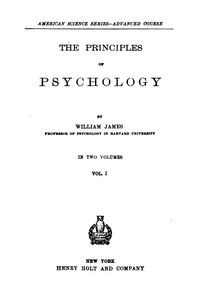
The Principles of Psychology, Volume 1 (of 2) by William James

(5 User reviews)   2195
By Charlotte Girard Posted on Jan 2, 2026
In Category - Adventure
James, William, 1842-1910 James, William, 1842-1910
English
Ever wonder why your mind works the way it does? Why a smell can trigger a memory, or why your attention jumps around? William James's classic isn't just a dusty textbook—it's a deep, surprisingly accessible adventure into the human mind. Forget what you think you know about psychology. This is the foundational text that asks the big questions about consciousness, habit, and the self. It's like having a brilliant, slightly eccentric professor guide you through the most fascinating subject there is: you. If you've ever been curious about your own thoughts, this book is your starting point.
Share

Read "The Principles of Psychology, Volume 1 (of 2) by William James" Online

This book is available in the public domain. Start reading the digital edition below.

START READING FULL BOOK
Instant Access    Mobile Friendly

Book Preview

A short preview of the book’s content is shown below to give you an idea of its style and themes.

7, 8, 10 (from page 330 to page 371), 12, 13, 15, 17, 20, 21, and 28. The better to awaken the neophyte's interest, it is possible that the wise order would be to pass directly from chapter 4 to chapters 23, 24, 25, and 26, and thence to return to the first volume again. Chapter 20, on Space-perception, is a terrible thing, which, unless written with all that detail, could not be fairly treated at all. An abridgment of it, called 'The Spatial Quale,' which appeared in the Journal of Speculative Philosophy, vol. xiii, p. 64, may be found by some persons a useful substitute for the entire chapter. I have kept close to the point of view of natural science throughout the book. Every natural science assumes certain data uncritically, and declines to challenge the elements between which its own 'laws' obtain, and from which its own deductions are carried on. Psychology, the science of finite individual minds, assumes as its data (1) _thoughts and feelings_, and (2) _a physical world_ in time and space with which they coexist and which (3) _they know_. Of course these data themselves are discussable; but the discussion of them (as of other elements) is called metaphysics and falls outside the province of this book. This book, assuming that thoughts and feelings exist and are vehicles of knowledge, thereupon contends that psychology when she has ascertained the empirical correlation of the various sorts of thought or feeling with definite conditions of the brain, can go no farther--can go no farther, that is, as a natural science. If she goes farther she becomes metaphysical. All attempts to _explain_ our phenomenally given thoughts as products of deeper-lying entities (whether the latter be named 'Soul,' 'Transcendental Ego,' 'Ideas,' or 'Elementary Units of Consciousness') are metaphysical. This book consequently rejects both the associationist and the spiritualist theories; and in this strictly positivistic point of view consists the only feature of it for which I feel tempted to claim originality. Of course this point of view is anything but ultimate. Men must keep thinking; and the data assumed by psychology, just like those assumed by physics and the other natural sciences, must some time be overhauled. The effort to overhaul them clearly and thoroughly is metaphysics; but metaphysics can only perform her task well when distinctly conscious of its great extent. Metaphysics fragmentary, irresponsible, and half-awake, and unconscious that she is metaphysical, spoils two good things when she injects herself into a natural science. And it seems to me that the theories both of a spiritual agent and of associated 'ideas' are, as they figure in the psychology-books, just such metaphysics as this. Even if their results be true, it would be as well to keep them, _as thus presented_, out of psychology as it is to keep the results of idealism out of physics. I have therefore treated our passing thoughts as integers, and regarded the mere laws of their coexistence with brain-states as the ultimate laws for our science. The reader will in vain seek for any closed system in the book. It is mainly a mass of descriptive details, running out into queries which only a metaphysics alive to the weight of her task can hope successfully to deal with. That will perhaps be centuries hence; and meanwhile the best mark of health that a science can show is this unfinished-seeming front. The completion of the book has been so slow that several chapters have been published successively in Mind, the Journal of Speculative Philosophy, the Popular Science Monthly, and Scribner's Magazine. Acknowledgment is...

This is a limited preview. Download the book to read the full content.

Let's be clear: this is not a story with a plot. It's a foundational exploration of the human mind. Think of it as a grand tour of consciousness itself. William James, often called the father of American psychology, takes you on a journey through topics like attention, memory, habit, and the sense of self. He doesn't just list facts; he builds a framework for understanding how our mental life works, piece by fascinating piece.

Why You Should Read It

This book changed how I think about thinking. James writes with a warmth and curiosity that's rare in academic texts. His ideas feel alive. When he talks about habit as the "flywheel of society," it clicks. You see your own routines in a new light. His exploration of the "stream of thought"—the idea that our consciousness is a continuous flow, not a series of separate snapshots—feels profoundly true. It's philosophy, science, and keen observation all woven together by a brilliant guide.

Final Verdict

Perfect for curious minds who enjoy big ideas and don't mind a slower, more thoughtful read. It's for the person who asks "why?" about their own emotions and thoughts. While it's essential for psychology students, any thoughtful reader can get a lot from James's insights. Just don't expect a quick, breezy read—this is a book to savor and discuss. It’s a classic for a reason.


📜 Open Access

This book is widely considered to be in the public domain. Feel free to use it for personal or commercial purposes.

Michael Thompson
1 year ago

After hearing about this author multiple times, the author's voice is distinct and makes complex topics easy to digest. This story will stay with me.

Kimberly Smith
11 months ago

Simply put, the plot twists are genuinely surprising. I will read more from this author.

Dorothy Lewis
1 year ago

Surprisingly enough, it creates a vivid world that you simply do not want to leave. Definitely a 5-star read.

Patricia Lee
1 year ago

Enjoyed every page.

Ava Brown
1 year ago

Based on the summary, I decided to read it and it challenges the reader's perspective in an intellectual way. This story will stay with me.


4.5
4.5 out of 5 (5 User reviews )

Add a Review

Your Rating *
There are no comments for this eBook.
You must log in to post a comment.
Log in


Related eBooks