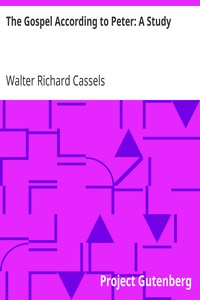
The Gospel According to Peter: A Study by Walter Richard Cassels

(2 User reviews)   2789
By Charlotte Girard Posted on Nov 15, 2025
In Category - Adventure
Cassels, Walter Richard, 1826-1907 Cassels, Walter Richard, 1826-1907
English
Have you ever wondered what the Bible would look like if one of the closest disciples wrote a completely different story? That's the wild idea at the heart of this old book I just read. It's not a novel, but a serious, century-old investigation into a text that claims to be the 'lost' gospel of Peter. The author, Walter Cassels, picks apart this ancient manuscript, asking if it's a genuine discovery or a clever fake. It's a deep dive into early Christian arguments, the fight over what the 'real' story of Jesus was, and how history gets written by the winners. If you like historical detective work about religion, this is a fascinating and surprisingly tense bit of scholarship.
Share

Read "The Gospel According to Peter: A Study by Walter Richard Cassels" Online

This book is available in the public domain. Start reading the digital edition below.

START READING FULL BOOK
Instant Access    Mobile Friendly

Book Preview

A short preview of the book’s content is shown below to give you an idea of its style and themes.

at once pass to the more recent, with which we have particularly to do. In the course of explorations carried on during the winter of 1886-87 by the order of M. Grébaut, then Director of the Museums of Egypt, two Greek manuscripts were discovered in the necropolis of Akhmîm, the ancient Panopolis, in Upper Egypt. The first of these was a papyrus, which was really found by some Fellahs who quarrelled regarding the partition of their precious booty and thus allowed the secret to leak out. It came to the knowledge of the Moudir, or Governor of the Province, who promptly settled the dispute by confiscating the papyrus, which he forwarded to the Museum of Gizeh at Boulaq. This MS. is a collection of problems in arithmetic and geometry, carefully written out, probably by a student, and buried with him as his highest and most valued achievement. The second manuscript was of much higher interest. It was discovered in the tomb of a “monk.” It consists of thirty-three pages in parchment, measuring 6 inches in height by 4-½ inches in breadth, without numbering, bound together in pasteboard covered with leather, which has become black with time. There is no date, nor any other indication of the approximate age of the MS. than that which is furnished by the characteristics of the writing and the part of the cemetery in which it was discovered. These lead to the almost certain conclusion, according to M. Bouriant, who first transcribed the text, that the MS. cannot be anterior to the eighth century or posterior to the twelfth. The ancient cemetery of Akhmîm stretches along to the north and west of the hill on which have been discovered tombs of the eighteenth to the twentieth dynasties, and it has served as a burial-place for the Christian inhabitants of the neighbourhood from the fifth to the fifteenth centuries, the more ancient part lying at the foot of the hill and extending gradually upward for about 700 metres. The tomb in which the MS. was found is in a position which approximately tallies, as regards age, with the date indicated by the MS. itself.(1) Of course, these indications refer solely to the date of the MS. itself, and not to the age of the actual works transcribed in its pages. The thirty-three sheets of parchment, forming sixty-six pages, commence with an otherwise blank page, bearing a rough drawing of a Coptic cross, upon the arms of which rise smaller crosses of the same description, and the letters [symbol] and [symbol] stand the one on the left, the other on the right of the lower stem of the large cross. Over the page commences a fragment of the “Gospel of Peter,” which continues to the end of page 10, where it abruptly terminates in the middle of a sentence. Pages 11 and 12 have been left blank. Pages 13 to 19 contain a fragment of the “Apocalypse of Peter,” beginning and ending abruptly, and these have, either by accident or design, been bound in the volume upside down and in reverse order, so that, as they actually stand, the text commences at page 19 and ends at page 13. Page 20 is again blank, and the rest of the volume is made up of two fragments of the ’Book of Enoch,’ the first extending from the 21st to the 50th page, and the second, written by a different hand, from the 51st to the 66th page. Finally, on the inside of the binding, and attached to it, is a sheet of parchment on which is written in...

This is a limited preview. Download the book to read the full content.

Walter Cassels's study isn't a story in the usual sense. It's an investigation. The plot, so to speak, follows the discovery and analysis of a manuscript called the 'Gospel of Peter.' This text surfaced in the 19th century and claimed to be the authentic, firsthand account of Jesus's trial, death, and resurrection, written by the Apostle Peter himself.

The Story

Cassels acts like a literary detective. He lays out this newly found gospel, line by line, and compares it to the familiar accounts in Matthew, Mark, Luke, and John. He highlights the strange differences: a more supernatural, almost ghostly Jesus, different details of the resurrection, and a perspective that early church leaders considered heretical. The central drama is intellectual: is this a real, suppressed record, or a later creation designed to push a specific theological agenda?

Why You Should Read It

This book pulls back the curtain on how the New Testament was formed. It shows that the early Christian world was full of competing voices and different versions of the core story. Reading Cassels argue his points makes you feel like you're in a dusty library, watching a scholar solve a puzzle. You get to see the early battles over faith and fact play out on the page. It challenges the idea of a single, simple history.

Final Verdict

This is for the curious reader who enjoys history, religion, or a good mystery. It's perfect if you've ever asked, 'How did we get this Bible?' It's not light reading—it's a dense, Victorian-era analysis—but its core question is thrilling. Think of it as a precursor to books like The Da Vinci Code, but with real footnotes and academic rigor. If you want to understand the controversies that shaped Christianity, start here.


📚 Legal Disclaimer

This title is part of the public domain archive. It is available for public use and education.

Daniel Johnson
11 months ago

To be perfectly clear, the narrative structure is incredibly compelling. Definitely a 5-star read.

Sandra Lopez
1 month ago

The formatting on this digital edition is flawless.
5
5 out of 5 (2 User reviews )

Add a Review

Your Rating *
There are no comments for this eBook.
You must log in to post a comment.
Log in


Related eBooks