
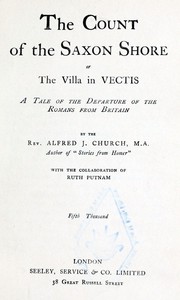
The Count of the Saxon Shore; or The Villa in Vectis. by Church and Putnam

(12 User reviews)   3088
By Charlotte Girard Posted on Nov 15, 2025
In Category - Adventure
Putnam, Ruth, 1856-1931 Putnam, Ruth, 1856-1931
English
Ever wonder what happened when the Romans packed up and left Britain? This book isn't about kings or famous battles—it’s about the people left behind. Imagine a young Roman boy, Caius, whose safe world on the Isle of Wight crumbles as Saxon ships appear on the horizon. His family’s villa becomes a fortress, and he has to grow up fast. It’s a story about holding onto home when everything familiar is slipping away. If you like historical fiction that feels personal and immediate, this quiet, forgotten gem is for you.
Share

Read "The Count of the Saxon Shore; or The Villa in Vectis. by Church and Putnam" Online

This book is available in the public domain. Start reading the digital edition below.

START READING FULL BOOK
Instant Access    Mobile Friendly

Book Preview

A short preview of the book’s content is shown below to give you an idea of its style and themes.

were representatives of every province of the Empire, Italy only excepted. They had been just receiving their pay, long in arrear, and now considerably short of the proper amount, and containing not a few coins which the receivers seemed to think of doubtful value. “Let me look at his Imperial Majesty,” said another speaker; and he scanned the features of the new Cæsar—features never very dignified, and certainly not flattered by the rude coinage—with something like contempt. “Well, he does not look exactly as a Cæsar should; but what does it matter? This will go down with Rufus at the wine-shop and Priscus the sausage-seller, as well as the head of the great Augustus himself.” “Ah!” said a third speaker, picking out from a handful of silver a coin which bore the head of Theodosius, “this was an Emperor worth fighting under. I made my first campaign with him against Maximus, another British Cæsar, by the way; and he was every inch a soldier. If his son were like him(3) things would be smoother than they are.” “Do you think,” said the second speaker, after first throwing a cautious glance to see whether any officer of rank was in hearing—“do you think we have made a change for the better from Marcus?(4) He at all events used to be more liberal with his money than his present majesty. You remember he gave us ten silver pieces each. Now we don’t even get our proper pay.” “Marcus, my dear fellow,” said the other speaker, “had a full military chest to draw upon, and it was not difficult to be generous. Gratianus has to squeeze every denarius out of the citizens. I heard them say, when the money came into the camp yesterday, that it was a loan from the Londinium merchants. I wonder what interest they will get, and when they will see the principal again.” “Hang the fat rascals!” said the other. “Why should they sleep soft, and eat and drink the best of everything, while we poor soldiers, who keep them and their money-bags safe, have to go bare and hungry?” “Come, come, comrades,” interrupted the first soldier who had spoken; “no more grumbling, or some of us will find the centurion after us with his vine-sticks.” The group broke up, most of them making the best of their way to spend some of their unaccustomed riches at the wine-shop, a place from which they had lately kept an enforced absence. Three or four of the number, however, who seemed, from a sign that passed between them, to have some secret understanding, remained in close conversation—a conversation which they carried on in undertones, and which they adjourned to one of the tents to finish without risk of being disturbed or overheard. The camp in which our story opens was a square enclosure, measuring some five hundred yards each way, and surrounded by a massive wall, not less than four feet in thickness, in the construction of which stone, brick, and tile had, in Roman fashion, been used together. The defences were completed by strong towers of a rounded shape, which had been erected at frequent intervals. The camp had, as usual, its four gates. That which opened upon the sea—for the sea washed the southern front—was famous in military tradition as the gate by which the second legion had embarked to take part in the Jewish War and the famous siege of Jerusalem. Vespasian, who had begun in Britain the great career which ended in the throne, had experienced its valour and discipline in more than one campaign,(5) and...

This is a limited preview. Download the book to read the full content.

Published in 1887, this book is a piece of historical fiction that has largely slipped from modern shelves, but it deserves a fresh look. It was co-authored by Alfred J. Church and Ruth Putnam, with Putnam often credited for bringing a keen eye for domestic and social detail to the grand sweep of history.

The Story

The tale is set in late Roman Britain, around 400 AD. The legions are withdrawing, leaving the province—the 'Saxon Shore'—vulnerable. We follow young Caius, who lives a sheltered life in his family's villa on Vectis (the Isle of Wight). His peaceful days of lessons and farm life are shattered when Saxon raiders begin their attacks. The story becomes one of sudden responsibility and survival. The villa transforms from a comfortable home into a defended stronghold, and Caius must navigate fear, loss, and the daunting task of protecting what remains of his world.

Why You Should Read It

What grabbed me was its focus on the 'aftermath.' We so often read about empires rising and falling, but this book sits in the tense, quiet space after the fall. You feel the anxiety of a community waiting for help that will never come. Caius is a relatable hero—not a warrior, but a scared kid forced to be brave. The authors make the ancient world feel lived-in, from the layout of the villa to the rhythms of daily life, which makes its threatened destruction all the more powerful.

Final Verdict

This is a perfect pick for readers who enjoy character-driven historical fiction or are fascinated by the 'Dark Ages' transition period. It’s not a bloody epic; it’s a thoughtful, sometimes melancholic look at the end of an era, seen through the eyes of a young man. If you’ve ever enjoyed Rosemary Sutcliff's novels or wanted a more intimate take on the end of Roman Britain, seek this one out. It’s a compelling snapshot of a world in twilight.


ℹ️ Legacy Content

This content is free to share and distribute. Feel free to use it for personal or commercial purposes.

Sandra Wilson
11 months ago

After hearing about this author multiple times, the character development leaves a lasting impact. Absolutely essential reading.

Donna Clark
4 months ago

I have to admit, the emotional weight of the story is balanced perfectly. I would gladly recommend this title.

Charles Lopez
1 year ago

The index links actually work, which is rare!

Robert Taylor
1 year ago

Amazing book.

Nancy King
1 year ago

Beautifully written.

5
5 out of 5 (12 User reviews )

Add a Review

Your Rating *
There are no comments for this eBook.
You must log in to post a comment.
Log in


Related eBooks