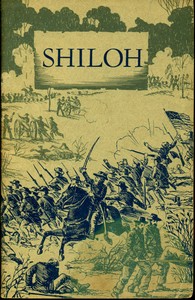
Shiloh National Military Park, Tennessee by Albert Dillahunty

(1 User reviews)   2614
By Charlotte Girard Posted on Nov 15, 2025
In Category - Adventure
Dillahunty, Albert Dillahunty, Albert
English
Hey, I just finished this book about Shiloh and it's not what you'd expect from a military park guide. Yeah, it covers the battle maps and troop movements, but the real story is about the people who were there. It makes you feel the confusion of that first day, the shock of the losses, and the quiet that fell over the field afterward. It's less about who won and more about what was lost. If you think you know the Civil War, this book will show you the human cost in a way that sticks with you long after you put it down.
Share

Read "Shiloh National Military Park, Tennessee by Albert Dillahunty" Online

This book is available in the public domain. Start reading the digital edition below.

START READING FULL BOOK
Instant Access    Mobile Friendly

Book Preview

A short preview of the book’s content is shown below to give you an idea of its style and themes.

by the fall of Forts Henry and Donelson, from the minds of Northerners. They now realized that the struggle was to be a long and bloody one. A few days after Donelson, one Union soldier wrote: “My opinion is that this war will be closed in less than six months from this time.” Shortly after Shiloh the same soldier wrote: “... if my life is spared I will continue in my country’s service until this rebellion is put down, should it be ten years.” Shiloh is not distinguished by outstanding generalship on either side, but it is interesting as a battle fought by raw volunteers—young men without previous experience in a major engagement and with little or no military training. _Preliminary Campaign_ War activity west of the Appalachian Mountains in 1861 was confined chiefly to the States of Kentucky and Missouri. Toward the end of the year when loyalty, or at least the neutrality, of the governments of these border States seemed assured, the Federals began making plans for the invasion of the South by way of the western rivers and railroads. Each side began to maneuver for strategic positions. The Confederate General, Leonidas Polk, believing that the Southern States were about to be invaded through Kentucky, moved up quickly from his position at Union City, Tenn., and seized Columbus, Ky., the northern terminus of the Mobile and Ohio Railroad. Gen. Ulysses S. Grant, recently appointed commander of the Federal troops in and around Cairo, Ill., had made preparations to occupy that important river port and railway center on the following day. Thwarted at Columbus, Grant retaliated by taking Paducah, Ky., located at the junction of the Tennessee and Ohio Rivers. It now became apparent to the Confederate high command in Richmond that a strong line would have to be established along the northwestern border of the Confederacy before the Union armies had time to occupy more of the strategic points. They believed that the task could be performed more effectively if all troops in that theater of operation were placed under one commander. Accordingly, Confederate President Jefferson Davis sent Gen. Albert Sidney Johnston to the West with the imposing title of “General Commanding the Western Department of the Army of the Confederate States of America.” Arriving in Nashville on September 14, 1861, General Johnston studied his difficult assignment. The line he was supposed to occupy extended from the mountains of eastern Tennessee westward across the Mississippi to the Kansas boundary. Only two points on the proposed line were then in Confederate hands: Columbus, which he considered the natural key to the Confederate defense of the Mississippi, and Cumberland Gap, Ky., which he had previously ordered Gen. Felix K. Zollicoffer to occupy. One of Johnston’s first official acts upon arriving at Nashville was to order Gen. Simon B. Buckner to secure Bowling Green, Ky., one of the most important railroad centers south of the Ohio. He also ordered garrisons to the incomplete works at Fort Henry, on the Tennessee, and Fort Donelson, on the Cumberland, hoping to prevent a Union advance up either of these natural highways. A Federal offensive up the Tennessee or the Cumberland would endanger the important railroad and industrial center of Nashville, Tenn. Since the outbreak of the war, Nashville had been converted into a huge arsenal and depot of supplies. Large quantities of food, clothing, and munitions had been collected and stored in its warehouses. Its factories were turning out percussion caps, sabers, muskets, saddles, harness, knapsacks, cannon, and rifled pieces. Its looms were turning out thousands of yards of gray cloth which were being...

This is a limited preview. Download the book to read the full content.

Albert Dillahunty's book is a guide to Shiloh National Military Park, but it reads like a walk across hallowed ground. It doesn't just list facts; it reconstructs the two bloody days in April 1862 that changed the war.

The Story

The book sets the scene for the battle that shocked both North and South. It follows the unprepared Union troops caught by surprise at their camps, the fierce fighting around the 'Hornet's Nest,' and the final stand at Pittsburg Landing. Using soldier accounts and clear maps, it shows how a simple plan fell apart in the chaos of the woods and how a battle expected to be quick turned into a slaughter. The story continues past the fighting, explaining how this field of carnage eventually became a place of remembrance.

Why You Should Read It

This book makes history feel immediate. Dillahunty has a gift for picking out the small, personal details from the official reports. You get a sense of the fear, the exhaustion, and the sheer disbelief at the scale of the violence. It's a powerful reminder that these were not just regiments on a map, but young men, many experiencing combat for the first time. The guide helps you understand the 'why' behind the park's monuments and preserved trenches.

Final Verdict

This is a must-read before you visit Shiloh. It's also perfect for anyone who wants to move past the textbook summaries of Civil War battles. It gives you the context to truly appreciate the silence of the park today. You'll walk away with a deeper understanding of the cost, making it meaningful for general readers and history enthusiasts alike.


🟢 Legacy Content

This is a copyright-free edition. Distribute this work to help spread literacy.

Mason Miller
1 year ago

Just what I was looking for.

4
4 out of 5 (1 User reviews )

Add a Review

Your Rating *
There are no comments for this eBook.
You must log in to post a comment.
Log in


Related eBooks