1

The Provinces of the Roman Empire, from Caesar to Diocletian. v. 1 — Inside the Classic
(0 User reviews)
271
Project Gutenberg
2015
Not confirmed
Rome -- History -- Empire, 30 B.C.-476 A.D.; Roman provinces -- Administration
Readers of public-domain and historical texts
Project Gutenberg digital edition
en
Edition facts
Words
155,447
Reading time
676 min
Text sections
17
For The Provinces of the Roman Empire, from Caesar to Diocletian. v. 1 — Inside the Classic, the stored edition analysis reports 155,447 words, 11 hr 16 min estimated reading time, and 17 detected text sections.
The text analysis averages about 24.5 words per sentence, while the detected sections provide another way to judge how the source is divided.
Project Gutenberg metadata also associates the work with “Rome -- History -- Empire, 30 B.C.-476 A.D.,” connecting these edition facts with the source record’s subject description.
Source:
Project Gutenberg record #48966
Mommsen's provincial history from Caesar to Diocletian, structured as separate regional narratives, with recurring images of frontier fortifications, military revolts, and pestilence, and a preface that frames the work as a corrective to public misunderstanding of the imperial period.
Read the complete public-domain text at its original source.
Read on Project GutenbergTheodor Mommsen’s The Provinces of the Roman Empire, from Caesar to Diocletian (Volume I) is not a continuous imperial narrative but a series of discrete provincial histories, each tracing the arc of Roman administration from conquest to crisis. The preface signals this structural choice: Mommsen argues that a comprehensive survey of the provinces is lacking, and that its absence has led to “incorrect and unfair” judgments of the imperial period. The work thus proceeds region by region—Spain, Gaul, the Danube lands, Asia Minor—rather than emperor by emperor.
Recurring motifs bind these separate accounts: the fortification and loss of frontiers, especially the Danube; the corrosive effect of military revolutions; and the devastation of pestilence, which in one passage “raged in all the years of distress” and claimed the emperor Claudius himself. These elements give the volume a thematic coherence despite its fragmented geography.
A Structure of Separate Histories
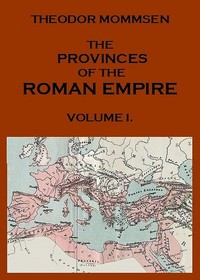
Mommsen organizes the volume not by chronology but by province, treating each region as a self-contained unit. The preface explains that this separation is “a preliminary requisite” for understanding the empire as a whole. The reader moves from the western provinces to the eastern, with each section detailing the local administration, military posts, and cultural changes under Roman rule. This structure means that events such as the Gothic wars of 250–269 appear in multiple chapters, viewed from different provincial perspectives. The approach prioritizes regional specificity over a unified imperial timeline, and the maps by Heinrich Kiepert reinforce this geographical emphasis.
Frontiers as Recurring Images
The Danube frontier dominates the excerpts, appearing as a line to be fortified, crossed, and re-established. Mommsen describes how Aurelian “withdrew the posts still holding out” in Dacia and resettled displaced inhabitants on the Moesian bank. The river is both a boundary and a conduit for invasion: Gothic forces use it to retreat, and Roman commanders cross it to strike at the Carpi and Goths. This image of the frontier as a permeable, contested space recurs throughout, contrasting with the more stable Mediterranean provinces. The repeated phrase “renewed fortifying of the Danube–frontier” underscores the cyclical labor of imperial defense.
Military Revolts and Internal Disorder
Mommsen attributes the empire’s third-century crises as much to internal military disloyalty as to barbarian pressure. He notes that “the untrustworthiness of the troops, far more than the superior power of the barbarians, called forth the flooding of the territory by land and sea robbers.” A quarrel in the Roman camp “between infantry and cavalry” nearly gave the Goths a respite, and the emperor Gallienus is depicted as unable to master the “hydra of military revolutions.” Claudius and Aurelian are praised for restoring order, but the excerpts suggest that the army’s volatility was a persistent structural weakness, not an occasional aberration.
Pestilence as a Narrative Force
Disease appears not as a metaphor but as a concrete historical actor. Mommsen reports that a “severe pestilence” raged during the Gothic wars, “especially in those regions, and above all in the armies,” and that it killed the emperor Claudius himself. The plague is linked to the destruction of cities and the weakening of Roman resistance. Yet Mommsen also notes that the “great army of the Northmen was utterly extirpated” by the combination of Roman victory and disease, suggesting that pestilence could work in Rome’s favor. This balanced treatment avoids moralizing, treating the epidemic as one factor among many in the complex calculus of war and survival.
Readers approaching this volume should expect to move slowly, province by province, rather than following a single narrative thread. Mommsen’s prose is dense with names of places, peoples, and commanders, and the maps are essential for orientation. The work rewards attention to recurring patterns—the fortification of rivers, the suppression of revolts, the impact of disease—that link the separate histories into a coherent portrait of an empire struggling to hold itself together. The preface’s warning about unfair judgments is a useful lens: Mommsen aims to complicate, not simplify, the story of Rome under the Caesars.
All those years among Mommsen's provincial lines—the frontiers, the mutinies, the slow rot of pestilence—I learned that Rome's grip was always a trembling hand. His preface speaks of correcting misunderstandings, but I found only melancholy. A quieter echo lives in The Defeat of Varus and the German Frontier Policy of Augustus — Reading Notes, where one lost legion still whispers beneath the clamor. They keep company, these two.
There are no reviews for this eBook.
There are no comments for this eBook.
Reader reflection
What was your reading experience?
Capture what you thought, learned, and would like to remember.
Your progress
0
/
10
2
What was your overall reaction to the book?
3
Would you recommend this book to another reader?
4
How demanding did the text feel?
5
Would a second reading be valuable?
6
Did the book meet your expectations?
7
Would this book work well in a reading group?
8
How much did the book move you?
9
What changed or sharpened your thinking?
10