1

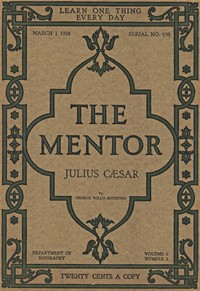
The Mentor: Julius Cæsar, Vol. 6, Num. 2, Serial No. 150, March 1, 1918 — Key Ideas to Explore
(0 User reviews)
98
Project Gutenberg
2016
1918
Caesar, Julius; Rome -- History -- Republic, 265-30 B.C.
Readers of public-domain and historical texts
Project Gutenberg digital edition
en
Edition facts
Words
13,407
Reading time
59 min
Text sections
8
The catalog record for The Mentor: Julius Cæsar, Vol. 6, Num. 2, Serial No. 150, March 1, 1918 — Key Ideas to Explore provides practical reading context through 13,407 words, 59 min estimated reading time, and 8 detected text sections.
The text analysis averages about 17.3 words per sentence, while the detected sections provide another way to judge how the source is divided.
Project Gutenberg metadata also associates the work with “Caesar, Julius,” connecting these edition facts with the source record’s subject description.
Source:
Project Gutenberg record #51110
This 1918 Mentor issue by George Willis Botsford examines Julius Caesar through physical description, political career, and reforms, drawing on Froude's portrait and archaeological details.
Read the complete public-domain text at its original source.
Read on Project GutenbergThe Mentor issue on Julius Caesar opens not with a battle or a political crisis but with a detailed physical portrait drawn from James Anthony Froude: Caesar was tall, pale, with dark gray eyes, a high voice, and a thick neck. The description dwells on his abstemious habits, his care for soldiers, and his avoidance of unnecessary danger. This emphasis on personal character sets the tone for a biographical sketch that treats Caesar’s body and bearing as evidence of his leadership.
A Career Built on Patronage and Performance
The narrative of Caesar’s rise is presented as a series of social and political obligations. Born of old patrician stock in 100 B.C., he received a Greek education in astronomy, philosophy, and rhetoric. To complete his oratorical studies he sailed for Rhodes, but was captured by pirates—a mishap he later avenged by manning a ship and punishing his captors. Returning to Rome, he entered politics, a vocation that required him to “pay his respects to men of influence, plead cases at court, and render financial or other assistance to unfortunate clients.” The text emphasizes the performative demands of Roman public life: calling everyone by name, entertaining lavishly, and maintaining a permanent coterie. This portrait of politics as a system of personal favors and public display frames Caesar’s ambition not as a solitary drive but as a mastery of social networks.
Civil War and the Question of Motive
The account of the civil war (49–45 B.C.) is notably terse. No sooner had Caesar finished his Gallic campaigns than he “came to blows with the Senate, which feared his towering ambition.” The text states that though the struggle appeared to be between Caesar and the Republic, its real object was to determine which of the two leading generals—Caesar or Pompey—should be master of the Roman world. Pompey was defeated and killed, and Caesar subdued the whole empire. The language is matter-of-fact, almost clinical, avoiding dramatic battle descriptions. The reader is left to infer the scale of the conflict from the brevity of the telling. This compression of warfare into a few sentences shifts attention away from military tactics and toward the political consequences of the war.
Reforms as a Mirror of Ambition
During and after the civil war, Caesar turned to internal reforms. The text lists his actions: forgiving political offenders, associating former enemies in government, and granting Roman citizenship freely to individuals and communities. His aim, the author writes, was “the rapid equalization of all freemen of the empire.” The description of public works is concrete: the completion of the temple to Jupiter, Juno, and Minerva; the Julian Forum with a temple to Venus Genetrix, from whom Caesar claimed descent; the rebuilding of the Curia; and the beginning of the Basilica Julia. The author notes that Caesar placed a statue of Venus by the sculptor Arcesilaus in the temple, “a remarkable example of clinging transparent drapery.” This detail, along with the mention of his planned canal through the Isthmus of Corinth, grounds Caesar’s ambition in material projects. The reform of the calendar—adopting the Egyptian solar year—is presented as a practical achievement that lasted until 1582.
Botsford’s Caesar is a figure seen through the lens of early twentieth-century biography: attentive to physical detail, social performance, and institutional reform. The narrative moves swiftly from personal description to political career to legislative accomplishment, with little pause for dramatic incident. Readers interested in how Caesar’s image was constructed in popular educational literature of the 1910s will find this a compact example of the genre.
That rain fell steady against the glass while I folded pages, noting how Botsford’s Caesar felt less marble statue, more restless man. Later, alone with the gray light, I drifted toward a different border—Teutoburg Forest, where another Roman ambition fractured. The quiet of those lost legions lingered longer than the triumph, and the afternoon shaped itself around that shift.The Defeat of Varus and the German Frontier Policy of Augustus — Reading Notes felt like finding the same ache, told from the other side.
There are no reviews for this eBook.
There are no comments for this eBook.
Reader reflection
Before you leave, reflect on the book
Use these questions to collect your thoughts before moving on.
Your progress
0
/
10
2
How did the book work for you overall?
3
How likely are you to recommend this book?
4
Did the language feel accessible?
5
How much did the book move you?
6
How strong was your personal connection to the text?
7
How useful were the ideas in this book?
8
Could you follow the author’s main argument?
9
In one sentence, what did you learn?
10