1

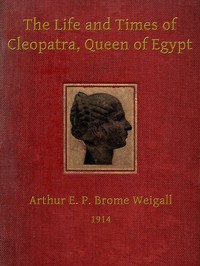
The life and times of Cleopatra, Queen of Egypt — Edition Insights
(0 User reviews)
532
Project Gutenberg
2017
Not confirmed
Cleopatra, Queen of Egypt, -30 B.C.; Queens -- Egypt -- Biography; Caesar, Julius -- Relations with women; Antonius, Marcus, 83 B.C.?-30 B.C. -- Relations with women; Egypt -- History -- 332-30 B.C.
Readers of public-domain and historical texts
Project Gutenberg digital edition
en
Edition facts
Words
127,621
Reading time
555 min
Text sections
28
For The life and times of Cleopatra, Queen of Egypt — Edition Insights, the stored edition analysis reports 127,621 words, 9 hr 15 min estimated reading time, and 28 detected text sections.
The text analysis averages about 32.4 words per sentence, while the detected sections provide another way to judge how the source is divided.
Project Gutenberg metadata also associates the work with “Cleopatra, Queen of Egypt, -30 B.C.,” connecting these edition facts with the source record’s subject description.
Source:
Project Gutenberg record #54038
Weigall's 1914 biography examines Cleopatra through her political alliances with Caesar and Antony, using ancient sources to reconstruct her character and the Ptolemaic court. The author's diction and narrative choices reveal a queen portrayed as both strategist and romantic figure, set against the backdrop of Rome's imperial rise.
Read the complete public-domain text at its original source.
Read on Project GutenbergWeigall opens his study with a striking epigraph from Isaiah—'Awake and sing, ye that dwell in dust'—immediately framing Cleopatra as a figure to be resurrected from fragmentary records. His preface thanks a circle of aristocratic readers, signaling the work's intended audience. The author, a British inspector-general of antiquities in Egypt, writes with the authority of an archaeologist but adopts the tone of a Victorian biographer, blending scholarly apparatus with dramatic narration.
Diction and the Construction of Character
Weigall's language consistently moralizes his subjects. Antony is described as having 'boyish extravagance' and being 'profoundly repentant' when wrong, a vocabulary that humanizes the Roman general while subtly judging him. The author uses Plutarch's anecdotes—such as Antony doubling a payment after his steward tried to curb his generosity—to illustrate a character defined by impulsive largesse. Weigall's own phrasing, calling Antony 'slow to see his own faults,' reinforces a portrait of a man governed by emotion rather than calculation. This diction choice aligns Antony with romantic tragedy rather than political cunning.
Narrative Structure and Source Handling
The biography is divided into two parts—'Cleopatra and Caesar' and 'Cleopatra and Antony'—a structure that mirrors the queen's political alliances. Weigall frequently cites classical authors like Plutarch and Appian, but he does not simply compile sources; he interprets them. For instance, when recounting Hybreas's complaint about double taxation, Weigall adds that Antony 'at once saw the sense of this,' a narrative gloss that implies the author's own judgment. The text weaves direct quotations (e.g., 'If it has not been paid to you...') with Weigall's connective tissue, creating a seamless story that occasionally blurs the line between ancient testimony and modern inference.
Recurring Motifs: Generosity and Its Costs
A repeated theme in the excerpts is Antony's open-handedness, presented as both virtue and flaw. Weigall notes that Antony's 'generous ways' helped his rise but also 'hastened his overthrow.' The steward's trick of piling silver coins to shock Antony into frugality backfires when Antony doubles the gift—a vignette that encapsulates the biography's tension between admiration and critique. This motif extends to Cleopatra by implication: the queen's own lavishness, though less detailed in the excerpts, is set against the backdrop of Roman austerity. Weigall's emphasis on generosity as a double-edged sword gives the narrative a moral undercurrent.
Setting and the Alexandria Atmosphere
Weigall devotes an entire chapter to Alexandria, describing it as a cosmopolitan city where Greek, Egyptian, and Roman cultures intersected. The excerpts do not include that chapter, but the preface and dedication to Ronald Storrs—'Oriental Secretary to the British Agency in Egypt'—hint at the author's firsthand familiarity with the region. The biography's setting is not merely geographical but political: Egypt is portrayed as a prize in Rome's civil wars. Weigall's subtitle, 'A Study in the Origin of the Roman Empire,' frames Cleopatra's story as part of a larger imperial narrative, making Alexandria a stage for world-historical drama.
Readers should approach Weigall's Cleopatra as a product of its era—Edwardian, imperial, and reliant on classical sources that the author treats with creative liberty. The biography rewards those interested in how early 20th-century scholarship shaped popular images of ancient figures. Pay attention to the footnotes and source citations, which reveal Weigall's method of stitching together Plutarch, Dio Cassius, and other writers into a coherent, if occasionally speculative, portrait.
There are books that leave a trace, like the faint scent of jasmine in an old room. Weigall's account of Cleopatra stayed with me that way—not just her politics, but her quiet maneuvering between two powerful men. I found myself thinking of her again the other day, and a friend mentioned Cleopatra: A Study — A Closer Reading, which touches something softer underneath the crown. It felt familiar, like returning to a conversation.
There are no reviews for this eBook.
There are no comments for this eBook.
Reader reflection
Take a moment to reflect on this book
Create a short personal record of your experience with this book.
Your progress
0
/
10
2
How much did you enjoy the reading experience?
3
How likely are you to recommend this book?
4
How much effort did this book require?
5
Would you start a conversation about this book?
6
Which part made the strongest impression?
7
How would you describe its reading pace?
8
How much did the book move you?
9
What changed or sharpened your thinking?
10