1

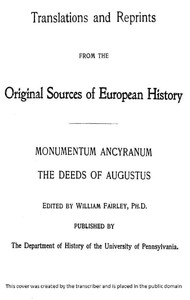
Monumentum Ancyranum: The Deeds of Augustus — Reading Notes
(0 User reviews)
835
Project Gutenberg
2021
Not confirmed
Augustus, Emperor of Rome, 63 B.C.-14 A.D.; Rome -- History -- Augustus, 30 B.C.-14 A.D. -- Sources
Readers of public-domain and historical texts
Project Gutenberg digital edition
en
Edition facts
Words
32,862
Reading time
143 min
Text sections
63
This digital edition of Monumentum Ancyranum: The Deeds of Augustus — Reading Notes is described by source-level measurements including 32,862 words, 2 hr 23 min estimated reading time, and 63 detected text sections.
The text analysis averages about 13.9 words per sentence, while the detected sections provide another way to judge how the source is divided.
Project Gutenberg metadata also associates the work with “Augustus, Emperor of Rome, 63 B.C.-14 A.D.,” connecting these edition facts with the source record’s subject description.
Source:
Project Gutenberg record #66595
This edition of the Monumentum Ancyranum presents the Res Gestae Divi Augusti in Latin, Greek, and English, with scholarly apparatus. Editor William Fairley collates post-Mommsen textual studies, corrects typographical errors, and provides notes that clarify military, financial, and ceremonial details, making the inscription accessible for historical and philological study.
Read the complete public-domain text at its original source.
Read on Project GutenbergWilliam Fairley’s 1898 edition of the Monumentum Ancyranum places the Latin and Greek texts of Augustus’s Res Gestae alongside a new English translation, with footnotes that track textual variants and historical references. The preface states that the English version is “the core of the work,” yet the editor also aims to serve philologists by presenting the original inscriptions “in such form as to be of real philological service.” Fairley draws heavily on Mommsen’s 1883 critical edition but incorporates later emendations and corrects “a large number of typographical errors” found there. The result is a compact scholarly tool that balances accessibility for non-specialists with precision for those reading the Latin or Greek.
A Tripartite Textual Strategy
The volume is structured around three parallel versions of the inscription: the Latin text (based on the Ancyra stone), a Greek translation from the same monument, and Fairley’s English rendering. This arrangement allows direct comparison of phrasing across languages. The Latin and Greek texts are annotated with footnotes that record alternative readings proposed by scholars such as Wölfflin and Bormann, often challenging Mommsen’s choices. For instance, a note on chapter 15 discusses whether Augustus meant “lands purchased by me” or “I have assigned lands,” showing how a single verb shift alters the emperor’s claim of personal expenditure. The English translation, though central, is not treated as definitive; the apparatus keeps the reader aware of textual instability.
Narrative Voice and Self-Presentation
Augustus’s first-person account—“I drove the men who slaughtered my father into exile”—is rendered in Fairley’s version with a plain, declarative tone that mirrors the original’s authoritative brevity. The notes, however, complicate this voice by cross-referencing other sources. A comment on the ovations after Philippi cites Suetonius and Dio, while a note on the title imperator explains its dual meaning as both a military acclamation and a permanent prefix. This editorial layer reveals how Augustus’s self-presentation was shaped by later conventions. The pace of the narrative is uneven: the English text moves briskly through lists of achievements, but the footnotes slow the reader with dense discussions of troop numbers, dates, and textual cruces, creating a rhythm of assertion and qualification.
Pace Shifts Between Text and Apparatus
The reading experience alternates between the swift, formulaic progress of the Res Gestae itself—where Augustus ticks off offices, expenditures, and victories in clipped sentences—and the deliberate, digressive footnotes that unpack each claim. A note on the 300 ships captured at Actium, for example, cites Appian and Plutarch to specify the exact numbers, while another on the term of service for legionaries (sixteen years, later raised to twenty) interrupts the main text with regulatory detail. This oscillation in pace is intentional: Fairley’s edition is designed for both consecutive reading and spot consultation. The supplement, chronological table, and bibliography further fragment the flow, turning the book into a reference work that invites jumping between sections rather than linear progress.
Readers approaching this edition should be prepared to navigate multiple layers: the imperial voice, the scholarly commentary, and the material history of the inscription itself. Fairley’s notes reward those who pause over textual variants or historical allusions, but the core English text can be read straight through for a concise statement of Augustus’s achievements. The volume is best used as a companion to other sources on Augustan Rome, not as a standalone narrative.
Holding this inscription, I remembered sitting with Monumentum Ancyranum in a quiet library, tracing Augustus’s careful boasts, and suddenly recalling how The History of Rome made those dry deeds feel urgent—Livy’s ghosts whispering through the same marble dust. The History of Rome, Books 09 to 26 — Context and Discussion once gave me that same ache, time folding into itself. I simply sat there, not reading, just feeling.
There are no reviews for this eBook.
There are no comments for this eBook.
Reader reflection
Before you leave, reflect on the book
Use these questions to collect your thoughts before moving on.
Your progress
0
/
10
2
What was your overall reaction to the book?
3
Would you pass this book on to a friend?
4
How easy was the book to follow?
5
Was the book easy to understand?
6
How would you describe its reading pace?
7
Did the book deliver what you hoped for?
8
How would you rate its originality?
9
Which lesson or insight stayed with you?
10