1

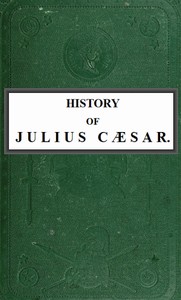
History of Julius Cæsar, Vol. 1 of 2 — Inside the Classic
(0 User reviews)
781
Project Gutenberg
2014
Not confirmed
Caesar, Julius; Rome -- History -- Republic, 265-30 B.C.
Readers of public-domain and historical texts
Project Gutenberg digital edition
en
Edition facts
Words
137,232
Reading time
597 min
Text sections
28
The catalog record for History of Julius Cæsar, Vol. 1 of 2 — Inside the Classic provides practical reading context through 137,232 words, 9 hr 57 min estimated reading time, and 28 detected text sections.
The text analysis averages about 19.9 words per sentence, while the detected sections provide another way to judge how the source is divided.
Project Gutenberg metadata also associates the work with “Caesar, Julius,” connecting these edition facts with the source record’s subject description.
Source:
Project Gutenberg record #45456
Napoleon III's 1865 history examines Rome's institutions and Caesar's rise, blending political analysis with imperial biography. The first volume covers Roman history before Caesar, focusing on the Republic's evolution and the interplay of factions, laws, and military expansion.
Read the complete public-domain text at its original source.
Read on Project GutenbergNapoleon III's History of Julius Cæsar, published in 1865, is as much a study of Roman statecraft as a biography. The first volume opens not with Caesar's birth but with a detailed account of Rome under the kings and the establishment of the consular republic, signaling that the author views Caesar's career as the culmination of institutional development. The work's structure—moving from social organization to conquests to Mediterranean prosperity—reflects a systematic, almost administrative approach to history, consistent with its author's own political experience.
Institutional Foundations and Political Tensions
The volume's early chapters dissect Roman institutions with a focus on their internal contradictions. Napoleon III describes the republic's "elements of dissolution" alongside its strengths, highlighting how the Senate's judicial power, the tribunes' authority, and the equestrian order's interests created persistent friction. A key passage notes that laws were proposed "to conciliate all interests" by drawing judges from three classes—Senate, equestrians, and treasury tribunes—yet this very balancing act reveals the fragility of consensus. The author's attention to procedural details, such as the restoration of tribunician rights and the amnesty for civil war participants, suggests that he sees legal mechanisms as both solutions and sources of conflict.
The Three Factions and Their Leaders
Napoleon III devotes considerable space to the political landscape of the late republic, drawing on Plutarch to delineate three factions: Pompey's moderate supporters, Caesar's bold followers, and Crassus's opportunistic middle. The author's characterization of Crassus as "fitter to serve as an instrument for the elevation of another" and his description of Pompey as "blind to real worth" reveal a clear hierarchy of capability. Caesar emerges as the most strategic actor, using his consulship to push through reforms—including the amnesty for Lepidus's army—while Pompey, despite his triumphs, loses ground by prioritizing popularity over conviction. The narrative emphasizes that Caesar's advantage lay in his "affable manners" and constant engagement with public life, a contrast to Pompey's reliance on past glory.
Military Expansion and the Treatment of Conquered Peoples
The chapters on Italy's conquest detail Rome's methods of subjugation, from the first Samnite war to the defeat of Pyrrhus. Napoleon III catalogs the "dispositions of the people of Italy" and the "treatment of the vanquished peoples," noting that Rome's success depended on a mix of coercion and integration. The author's interest in administrative outcomes—such as the "preponderance of Rome" and the "strength of the institutions"—reflects a pragmatic view of empire-building. The inclusion of a chapter on Mediterranean prosperity before the Punic wars suggests that Napoleon III sees economic context as essential to understanding military power, though the excerpts provide only the chapter title without elaboration.
Readers should approach this volume as a work of political analysis by a ruler who saw parallels between ancient Rome and his own empire. Napoleon III's emphasis on institutional mechanics and factional maneuvering offers a distinctive lens, but the incomplete excerpts leave questions about how he handles Caesar's early career. The detailed table of contents provides a useful roadmap for navigating the book's thematic structure.
There are moments in Napoleon’s history of Caesar—amid the Senate’s quarrels and the legions’ discipline—when I found myself thinking of another solitary military mind, waiting in the cold outside Rome’s gates. Both books feel like watching a distant storm gather, slowly, before thunder. That quiet ache for a vanished world lingers still, especially in Hannibal Makers of History — Key Ideas to Explore, where the same landscape breathes with an older, sadder urgency.
There are no reviews for this eBook.
There are no comments for this eBook.
Reader reflection
Record your reading impressions
A brief reflection can help important ideas stay with you longer.
Your progress
0
/
10
2
Did this book hold your interest?
3
Would you encourage someone else to read it?
4
Did the language feel accessible?
5
Did any part of the book stay with you emotionally?
6
Did you relate to its people, ideas, or situations?
7
Was the book moving at the right speed?
8
Could you follow the author’s main argument?
9
Which lesson or insight stayed with you?
10