1

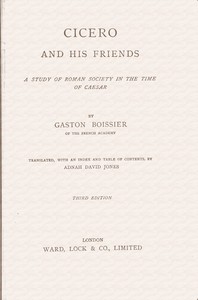
Cicero and his friends — A Closer Reading
(0 User reviews)
604
Project Gutenberg
2023
Not confirmed
Statesmen -- Rome -- Biography; Authors, Latin -- Biography; Rome -- History -- Republic, 265-30 B.C.; Cicero, Marcus Tullius -- Friends and associates
Readers of public-domain and historical texts
Project Gutenberg digital edition
en
Edition facts
Words
133,094
Reading time
579 min
Text sections
20
Before opening Cicero and his friends — A Closer Reading, the edition data offers a quick orientation: 133,094 words, 9 hr 39 min estimated reading time, and 20 detected text sections.
The text analysis averages about 25.3 words per sentence, while the detected sections provide another way to judge how the source is divided.
Project Gutenberg metadata also associates the work with “Statesmen -- Rome -- Biography,” connecting these edition facts with the source record’s subject description.
Source:
Project Gutenberg record #72216
Gaston Boissier's study of Cicero's letters as a window into Roman society, focusing on the structure of private correspondence, recurring images of urban violence, and movement between public and private spheres.
Read the complete public-domain text at its original source.
Read on Project GutenbergBoissier opens not with Cicero himself but with the letters as a genre, arguing that ancient private correspondence held a public weight unfamiliar to modern readers. The book's structure mirrors this tension: each chapter moves between Cicero's political maneuvers and his domestic life, between the Forum's clamor and the quiet of his villas. The excerpts show Boissier weaving together specific details—the organization of Clodius's gangs into decuries and centuries, the temple of Castor as an arsenal, the rostrum taken by storm—to build a picture of a society where violence was routine. This editorial note traces how the work's arrangement and recurring images shape its argument.
Letters as a Structural Frame
Boissier does not narrate Cicero's life chronologically. Instead, he uses the letters as a structural spine, grouping them by correspondent and theme. The introduction establishes that Cicero's correspondence was not meant for publication, yet it reveals more than formal histories. Each subsequent chapter—on Atticus, Caelius, Caesar, Brutus—takes a single relationship and examines it through the letters exchanged. This method allows Boissier to move from intimate advice to public events without losing focus. For instance, the chapter on Caesar in Gaul draws heavily on Cicero's letters to his brother Quintus and to Trebatius, which Boissier claims supplement the Commentaries. The structure thus mirrors the epistolary form itself: fragmentary, personal, yet always aware of the larger political stage.
Recurring Images of Urban Violence
Throughout the excerpts, Boissier returns to scenes of mob violence with almost cinematic detail. He describes Clodius's recruitment near the Aurelian steps, the gladiators and herdsmen fetched from Picenum, the shops ordered closed before a demonstration. One passage imagines London with the slave population of New Orleans and the police of Constantinople, a striking analogy that underscores the lawlessness. These images are not decorative; they serve to explain Cicero's political choices. The violence is shown as systemic, not episodic—the senate itself loses dignity, debating with 'revolting coarseness,' and Cicero hurls insults like 'swine' and 'rotten flesh.' Boissier uses these recurring scenes to argue that Cicero's wavering between parties was a rational response to an ungovernable city.
Movement Between Public and Private Spheres
Boissier constantly shifts the reader's attention from the Forum to the household. The chapter on Cicero's private life examines his wealth, his marriages, his children, his slaves—details that humanize the orator. But this movement is never sentimental. Boissier shows how Cicero's domestic arrangements were entangled with his public standing: his son's education, his wife's dowry, his freedmen's loyalties all had political implications. The same pattern appears in the portrait of Atticus, who deliberately avoided public life yet remained at the center of Roman politics through his correspondence. By alternating between these spheres, Boissier suggests that the boundary between public and private was porous in late Republican Rome, and that Cicero's letters are valuable precisely because they cross that boundary constantly.
Caesar's Absence and Presence
Caesar appears in the excerpts mainly through his effect on others. Boissier devotes a long section to Cicero's letters from Gaul, but Caesar himself is often offstage, a force whose victories are felt in Rome rather than described. The chapter 'The Victor and the Vanquished' examines how Caesar tried to conciliate the Republican party after his triumph, appointing its members to offices—yet Boissier notes the 'profound discontent' that remained. This indirect treatment is deliberate: the book is about Cicero and his friends, not Caesar. Yet Caesar's shadow looms over every relationship. The chapter on Caelius ends with his death after joining Caesar's party and then turning against him; the chapter on Brutus focuses on his family and education, leading toward his eventual role in the assassination. Boissier uses these trajectories to show how Caesar's rise fractured old loyalties.
Readers coming to this work for a straightforward biography will find instead a mosaic of relationships. Boissier's method rewards attention to the letters he quotes and the details he selects—the gladiators in the Forum, the slaves in Cicero's household, the exiles recalled through his influence. The book is best read as a series of linked portraits, each illuminated by the correspondence that survives. Let the letters guide you: they are the thread that holds the fragments together.
Leafing through Cicero and his friends, I lingered on those letters written amid street clamor, the private voice striving against public chaos. It made me think of another long shadow—the solitary figure crossing Alps with elephants, equally haunted by Rome’s relentless pull. The same ache of distance, perhaps. Hannibal Makers of History — Key Ideas to Explore came to mind, quietly, like an old echo.
There are no reviews for this eBook.
There are no comments for this eBook.
Reader reflection
Record your reading impressions
A brief reflection can help important ideas stay with you longer.
Your progress
0
/
10
2
How much did you enjoy the reading experience?
3
Would you recommend this book to another reader?
4
How much effort did this book require?
5
How clear did the writing feel?
6
How would you rate its originality?
7
How did the reading compare with what you expected?
8
Which aspect of the book did you value most?
9
In one sentence, what did you learn?
10