1

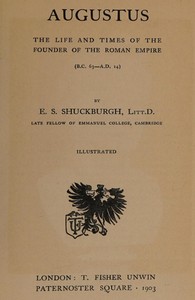
Augustus: The Life and Times of the Founder of the Roman Empire — Reading Companion
(0 User reviews)
127
Project Gutenberg
2021
Not confirmed
Emperors -- Rome -- Biography; Rome -- History -- Augustus, 30 B.C.-14 A.D.; Augustus, Emperor of Rome, 63 B.C.-14 A.D.
Readers of public-domain and historical texts
Project Gutenberg digital edition
en
Edition facts
Words
113,557
Reading time
494 min
Text sections
27
Augustus: The Life and Times of the Founder of the Roman Empire — Reading Companion can be approached with a clearer sense of reading commitment from its source measurements: 113,557 words, 8 hr 14 min estimated reading time, and 27 detected text sections.
The text analysis averages about 20.5 words per sentence, while the detected sections provide another way to judge how the source is divided.
Project Gutenberg metadata also associates the work with “Emperors -- Rome -- Biography,” connecting these edition facts with the source record’s subject description.
Source:
Project Gutenberg record #66609
Evelyn S. Shuckburgh's 1903 biography examines Augustus's statesmanship through detailed narrative, contrasting his methodical governance with Julius Caesar's genius. The text balances military campaigns, administrative reforms, and personal relationships, with a measured tone that shifts between strategic analysis and vivid episode.
Read the complete public-domain text at its original source.
Read on Project GutenbergShuckburgh opens his biography by directly confronting the comparative neglect of Augustus by biographers, noting that 'the soldier is more interesting than the statesman' and that Julius Caesar's 'note of genius' overshadowed his nephew's achievements. This framing establishes a central tension: the book aims to recover Augustus's reputation as a ruler who 'evoked order out of chaos' through careful, unglamorous work. The preface sets a tone of measured admiration, emphasizing Augustus's role as an 'inspirer, careful organiser, unwearied manipulator of details' rather than a charismatic military hero.
The narrative voice throughout is scholarly yet accessible, with Shuckburgh frequently pausing to weigh evidence—as when he discusses the possible third closing of the Temple of Janus, listing Horace's poems, Dio's account, and an inscription as 'strong presumption' rather than proof. This cautious, evidence-based approach gives the biography a distinctive rhythm of assertion qualified by uncertainty.
A Biographer's Balancing Act: Statesman vs. Soldier
Shuckburgh's preface explicitly frames Augustus as less attractive to biographers than Julius Caesar, yet the author's own method reveals a deep fascination with administrative competence. The opening contrast between 'soldier' and 'statesman' recurs throughout the excerpts, particularly in descriptions of military campaigns that are swiftly folded into larger political calculations. For instance, the campaign against Alpine tribes in 15 B.C. is narrated with tactical detail—Tiberius's 'masterly plan,' Drusus's victory near Lake Garda—but the passage concludes by noting the annexation of Noricum and formation of the province of Raetia, shifting focus from battlefield to bureaucratic outcome.
This pattern suggests Shuckburgh's primary interest lies not in combat but in how military success translated into stable governance. The narrative pace accelerates during battle descriptions, then slows for administrative consequences, creating a distinctive rhythm that prioritizes long-term statecraft over momentary heroism.
The Weight of Evidence: Shuckburgh's Cautious Voice
A notable feature of Shuckburgh's prose is his willingness to acknowledge uncertainty. When discussing whether the Temple of Janus was closed for a third time in 13 B.C., he enumerates four pieces of evidence—Horace's odes, Dio's history, the lull in German troubles, and an inscription—then concludes they form 'a strong presumption' rather than proof. This judicial tone appears repeatedly: phrases like 'not certain,' 'some good reasons for supposing,' and 'none of these are in themselves absolute proofs' signal a historian who values precision over narrative smoothness.
This cautious voice extends to character judgments. Of Agrippa, Shuckburgh notes that 'the passion for prurient scandal, characteristic of the age and people, for once is silent,' a remark that simultaneously praises Agrippa's integrity and critiques Roman gossip culture. Such asides reveal a biographer attentive to the biases of his sources, adding a layer of historiographical awareness to the political narrative.
Pace and Structure: From Crisis to Ceremony
The excerpts show Shuckburgh varying his narrative pace to match Augustus's own shifts between crisis management and ceremonial consolidation. After the military campaigns of 15-13 B.C., the text slows for a detailed account of Augustus's return to Rome: his deliberate night entry to avoid a complimentary procession, the solemn laying of laurels on Jupiter's knees, and the first senatorial business of settling soldiers' claims. This ceremonial set-piece contrasts with the rapid-fire campaign narrative that precedes it, mirroring Augustus's own alternation between war and administrative reform.
Similarly, the death of Agrippa in 12 B.C. is introduced abruptly—'However, before the year was ended, news came of disturbances in Pannonia'—then treated with elegiac expansion: 'Never had ruler a more faithful or abler friend and servant.' This structural pattern of sudden event followed by reflective commentary gives the biography a rhythm that feels both episodic and cumulative, emphasizing how personal loss intersected with political necessity.
Readers approaching this biography should attend to Shuckburgh's careful modulation between military narrative and administrative analysis, as well as his habit of weighing evidence explicitly. The book rewards those interested in how a historian constructs a portrait from fragmentary sources, rather than those seeking a swift, dramatic life story. The author's own admission that Augustus 'has been much less attractive to biographers than Iulius' becomes a challenge to the reader: to find fascination in the patient work of empire-building.
There’s something steadying about Shuckburgh’s Augustus, this methodical man building an empire brick by administrative brick, so unlike Caesar’s lightning. Reading it, I kept thinking how that same Roman order eventually loosened, how Decline and Fall’s slow unraveling feels almost like a quiet exhale after such striving. History of the Decline and Fall of the Roman Empire — Volume 4 — A Reader’s Guide carries that same melancholy, the long afternoon of a world.
There are no reviews for this eBook.
There are no comments for this eBook.
Reader reflection
What was your reading experience?
Capture what you thought, learned, and would like to remember.
Your progress
0
/
10
2
Was reading this book enjoyable?
3
Is this a title you would suggest to others?
4
What was the reading difficulty like?
5
How clear did the writing feel?
6
Was the book moving at the right speed?
7
How would you rate its originality?
8
Did this book create an emotional response?
9
What did this book teach you most?
10