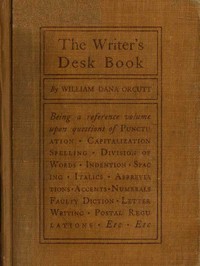
The Writer's Desk Book by William Dana Orcutt

(3 User reviews)   3344
By Charlotte Girard Posted on Dec 26, 2025
In Category - Philosophy
Orcutt, William Dana, 1870-1953 Orcutt, William Dana, 1870-1953
English
Hey, I just read this old book that feels like finding a secret toolbox for writers. It's called 'The Writer's Desk Book' and it's not a story—it's a practical guide from 1912. The main thing it tackles? How to actually get your writing out of your head and into the world, professionally. It solves the mystery of 'what do I do after I have an idea?' by laying out all the nuts and bolts of submitting work, understanding copyright, and dealing with publishers. It's like a time capsule of advice that's surprisingly still useful. If you've ever felt lost about the business side of writing, this little manual is a fascinating and comforting peek behind the curtain.
Share

Read "The Writer's Desk Book by William Dana Orcutt" Online

This book is available in the public domain. Start reading the digital edition below.

START READING FULL BOOK
Instant Access    Mobile Friendly

Book Preview

A short preview of the book’s content is shown below to give you an idea of its style and themes.

were the pioneers in establishing a basis for systematic punctuation. From this chaotic condition definite rules have gradually been evolved for general guidance, but judgment and taste must always be the final guides to correct punctuation. Assistance may be obtained by observing a few simple rules which are based upon the idea that the purpose of every punctuation mark is to indicate to the eye the construction of the sentence in which it occurs. No one of the various punctuation marks should ever be used exclusively or to excess, for each one has some specific duty which it can perform better than any other. It is always wise to question why, in a given case, a punctuation mark should be put in rather than why it should be left out, for of the two evils an over-punctuated book is the more objectionable. “Close punctuation,” {4} characterized by the use of many commas, prevailed in the English of the eighteenth century and is today the best French usage, but “open punctuation,” which avoids the use of any point not clearly required by the construction, is now favored by the best English writers. THE COMMA Dean Alford once wrote, in disgust, “The great enemies to understanding anything in our language are the commas,” and prided himself that in the course of editing the Greek text of the New Testament, he destroyed more than a thousand of these “enemies.” The chief use of this, the smallest degree of separation, is to define the particles and minor clauses of a sentence. It should always be placed inside the quotation-marks when used in connection with them. The comma is required: 1. Before a conjunction when the preceding word is qualified by an expression which is not intended to qualify the word following the conjunction: e.g., _He suddenly started, and fell_. 2. Between adjectives and adverbs when not connected by a conjunction: _He possessed a calm, exasperating manner_; but the comma may be omitted between two adjectives when the idea is close: e.g., _A clear cold day_. {5} 3. After adjectives and adverbs where three or more are used in succession: e.g., _The man possessed a calm, cynical, exasperating manner_. 4. In a succession of three or more words where the conjunctive _and_ is used before the last one: e.g., _He was tall, thin, and pale_. 5. When the word after the conjunction is followed by an expression which qualifies that word alone: e.g., _’Twas certain he could write, and cipher too._ 6. After inverted phrases and clauses: e.g., _Discouraged by constant opposition, he resigned his position_. Short phrases of similar nature do not require the comma: e.g., _Of his intentions there could be no doubt_. 7. To separate the adverbs _however_, _now_, _then_, _too_, _perhaps_, and _indeed_ from the context when they are used as conjunctions: e.g., _This idea, however, had not occurred to him_. When these words are used as adverbs, the comma is not required: e.g., _It must be done, however contrary it may be to our present advantage_. 8. To separate parenthetical or intermediate expressions from the context: e.g., _His intentions, though at first concealed, became obvious_. 9. After the last word of a series composed of several words not connected by conjunctions: e.g., _The men, the women, the children even, were up in arms_. {6} 10. Between words or phrases in apposition with each other: e.g., _I refer to Mr. Taylor, the father of Scientific Management_. But when used as a single phrase or a compound name, no comma is required: e.g., _The poet Tennyson was born in 1809_. 11. Between...

This is a limited preview. Download the book to read the full content.

Published in 1912, The Writer's Desk Book is exactly what it sounds like: a reference guide meant to sit on a writer's desk. Forget plot twists and characters—this book is all about the how-to. William Dana Orcutt, a publisher and author himself, compiled clear explanations and samples for the everyday tasks writers face.

The Story

There's no narrative here. Instead, think of it as an owner's manual for a writing career. Orcutt walks you through formatting a manuscript the right way, writing a professional cover letter to an editor, and understanding the different rights you sell when you publish something. He includes examples of correct proofreader's marks, explains copyright law (as it stood then), and even gives tips on keeping records of your submissions. The whole book is built to answer the practical questions that can stump a new writer.

Why You Should Read It

Reading this today is a strange and wonderful experience. On one hand, some details are charmingly outdated (like specific postage rates). On the other, the core advice about being professional, precise, and persistent is timeless. It's a reminder that the struggles of writers—wanting to be taken seriously, navigating the publishing world—haven't changed much in over a century. There's a real sense of solidarity in seeing these same issues laid out so plainly by someone from a completely different era.

Final Verdict

This is a niche but delightful find. It's perfect for history lovers, aspiring writers curious about the past, or anyone who enjoys old instructional manuals. You won't get writing prompts or inspiration, but you'll get a fascinating look at the machinery behind getting words into print. It's more of a curious artifact than an active guide, but it's full of respect for the craft and a surprising amount of still-relevant wisdom.


🏛️ Copyright Free

The copyright for this book has expired, making it public property. You are welcome to share this with anyone.

Kenneth Lopez
1 year ago

Beautifully written.

Elijah Nguyen
1 year ago

If you enjoy this genre, the emotional weight of the story is balanced perfectly. Highly recommended.

Elizabeth Lee
6 months ago

I didn't expect much, but the content flows smoothly from one chapter to the next. I couldn't put it down.
5
5 out of 5 (3 User reviews )

Add a Review

Your Rating *
There are no comments for this eBook.
You must log in to post a comment.
Log in


Related eBooks