
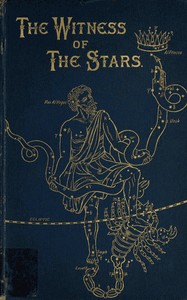
The Witness of the Stars by E. W. Bullinger

(10 User reviews)   3289
Bullinger, E. W. (Ethelbert William), 1837-1913 Bullinger, E. W. (Ethelbert William), 1837-1913
English
Ever looked up at the night sky and wondered if there was more to those constellations than just random stars? That's exactly what E.W. Bullinger asks in 'The Witness of the Stars.' This isn't your typical astronomy book. Instead, it presents a wild idea: what if the ancient names and stories behind the zodiac and other star groups were actually a forgotten language, a celestial storybook telling a single, unified prophecy from the dawn of time? Bullinger connects the dots between ancient myths, star names, and biblical narratives, suggesting a hidden message has been written in the heavens for millennia. It's a fascinating, mind-bending read that will completely change how you see the twinkling lights above. Whether you're a skeptic or a believer, it makes you think.
Share

Read "The Witness of the Stars by E. W. Bullinger" Online

This book is available in the public domain. Start reading the digital edition below.

START READING FULL BOOK
Instant Access    Mobile Friendly

Book Preview

A short preview of the book’s content is shown below to give you an idea of its style and themes.

first to create an interest in this important subject. Since then Dr. Seiss, of Philadelphia, has endeavoured to popularize her work on the other side of the Atlantic; and brief references have been made to the subject in such books as _Moses and Geology_, by Dr. Kinns, and in _Primeval Man_; but it was felt, for many reasons, that it was desirable to make another effort to set forth, in a more complete form, the _witness of the stars to prophetic truth_, so necessary in these last days. To the late Miss Rolleston, however, belongs the honour of collecting a mass of information bearing on this subject; but, published as it was, chiefly in the form of _notes_, unarranged and unindexed, it was suited only for, but was most valuable to, the student. She it was who performed the drudgery of collecting the facts presented by Albumazer, the Arab astronomer to the Caliphs of Grenada, 850 A.D.; and the Tables drawn up by Ulugh Beigh, the Tartar prince and astronomer, about 1450 A.D., who gives the Arabian Astronomy as it had come down from the earliest times. Modern astronomers have preserved, and still have in common use, the ancient names of over a hundred of the principal stars which have been handed down; but now these names are used merely as a convenience, and without any reference to their significance. This work is an attempt to popularize this ancient information, and to use it in the interests of truth. For the ancient astronomical facts and the names, with their signification, I am, from the very nature of the case, indebted, of course, to all who have preserved, collected, and handed them down; but for their interpretation I am alone responsible. It is for the readers to judge how far my conclusions are borne out by the evidence; and how far the foundation of our hopes of coming glory are strengthened by the prophecies which have been written in the stars of heaven, as well as in the Scriptures of truth. For the illustrations I am greatly indebted to Jamieson’s _Celestial Atlas_, 1820; Flammarion’s _L’Étoiles_; Sir John W. Lubbock’s _Stars in Six Maps_, 1883; and to the late Mr. Edward J. Cooper’s _Egyptian Scenery_, 1820. For the general presentation and arrangement of the Constellations I am responsible, while for the drawings my thanks are due to my friend Miss Amy Manson. It is the possession of “that blessed hope” of Christ’s speedy return from Heaven which will give true interest in the great subject of this book. No one can dispute the antiquity of the Signs of the Zodiac, or of the Constellations. No one can question the accuracy of the ancient star‐names which have come down to us, for they are still preserved in every good celestial atlas. And we hope that no one will be able to resist the cumulative evidence that, apart from God’s grace in Christ there is no hope for sinners now: and apart from God’s glory, as it will be manifested in the return of Christ from Heaven, there is no hope for the Church, no hope for Israel, no hope for the world, no hope for a groaning creation. In spite of all the vaunted promises of a religious World, and of a worldly Church, to remove the effects of the curse by a Social Gospel of Sanitation, we are more and more shut up to the prophecy of Gen. iii. 15, which we wait and long to see fulfilled in Christ as our only hope. This is beautifully expressed by the late Dr....

This is a limited preview. Download the book to read the full content.

Let's be clear: this book is not about horoscopes. It's the opposite. First published in 1893, E.W. Bullinger's 'The Witness of the Stars' makes a bold claim. He argues that the original constellations and their ancient names—long before they were tied to astrology—formed a coherent pictorial story. This story, he says, was a global, ancient prophecy about a promised redeemer, a saga of conflict and ultimate victory that was later corrupted into the myths of Greece, Rome, and other cultures.

The Story

There isn't a plot with characters in the traditional sense. The 'story' is the sky itself. Bullinger walks us through the major constellations, starting with Virgo (the Virgin) and ending with Leo (the Lion). He digs into the often-shocking meanings of their ancient Hebrew, Egyptian, and Akkadian names. He connects these celestial images into a narrative arc: a promised child is born (Virgo), faces a deadly enemy (Scorpio), is sacrificed (Crux, the Southern Cross), and triumphs as a conquering king (Leo). He uses astronomy, ancient languages, and biblical references to build his case that this was an original 'gospel in the stars.'

Why You Should Read It

Even if you don't buy the central premise, the journey is incredible. Bullinger pulls back the curtain on how ancient people saw the cosmos, not as random dots, but as a grand canvas. Learning that the star 'Spica' in Virgo's hand means 'the branch' or that 'Arcturus' in Bootes means 'the guardian' gives the sky a depth I never knew it had. It makes you appreciate the human desire to find meaning and story everywhere, especially in the vast, silent night. It's a unique blend of theology, astronomy, and ancient history that feels like solving a cosmic puzzle.

Final Verdict

This book is perfect for curious minds who love history, astronomy, or unconventional theories. It's for the person who looks at the Big Dipper and wonders, 'Why is it called that? Who decided?' If you enjoy books that challenge mainstream thought and connect seemingly unrelated dots across cultures and time, you'll find this captivating. Approach it with an open mind—not necessarily to agree, but to explore one of the most intriguing 'what if' scenarios ever written about the stars above us.


🔖 Legal Disclaimer

This digital edition is based on a public domain text. Use this text in your own projects freely.

Linda Smith
1 week ago

From the very first page, the arguments are well-supported by credible references. Highly recommended.

Charles Davis
1 month ago

Without a doubt, it challenges the reader's perspective in an intellectual way. Definitely a 5-star read.

Donald Martin
1 year ago

Wow.

Paul Robinson
1 year ago

Helped me clear up some confusion on the topic.

Susan Lewis
1 year ago

Compatible with my e-reader, thanks.

4.5
4.5 out of 5 (10 User reviews )

Add a Review

Your Rating *
There are no comments for this eBook.
You must log in to post a comment.
Log in


Related eBooks