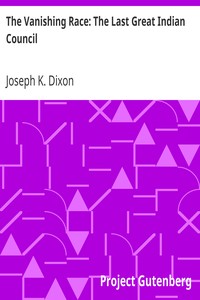
The Vanishing Race: The Last Great Indian Council by Joseph K. Dixon

(2 User reviews)   2690
Dixon, Joseph K. (Joseph Kossuth), 1856-1926 Dixon, Joseph K. (Joseph Kossuth), 1856-1926
English
Picture this: 1909, a dusty Montana valley, and over 200 Native American leaders from tribes across the continent gather. They know their traditional way of life is slipping away. Joseph K. Dixon was there with a camera and a mission. His book, 'The Vanishing Race,' is more than photos and speeches. It's a powerful, haunting record of a final, desperate attempt to be heard. This isn't just history; it's the urgent, collective voice of a people at a turning point, captured right before the world changed forever. It will make you think differently about the American West.
Share

Read "The Vanishing Race: The Last Great Indian Council by Joseph K. Dixon" Online

This book is available in the public domain. Start reading the digital edition below.

START READING FULL BOOK
Instant Access    Mobile Friendly

Book Preview

A short preview of the book’s content is shown below to give you an idea of its style and themes.

games, their warfare, religion, and the country in which they live. As a result, on Washington’s Birthday, 1913, thirty-two Indian chiefs, representing eleven tribes, assembled with the President of the United States together with many eminent citizens and details from the Army and Navy to open ground for the Indian Memorial authorized by act of Congress to be erected in the harbour of New York. The Indian chiefs assembled, hoisted the American flag, the first time in their history. This act and the flag gave birth to a thrill of patriotism. These warriors of other days laid claim to a share in the destiny of our country. So deeply were these First Americans impressed with a sense of loyalty to the flag that, again under the authority of the President of the United States, a third Expedition was sent forth to every Indian tribe. The purpose of this Expedition was twofold, the linking of every tribe in the country with the National Indian Memorial, and the inspiring of an ideal of patriotism in the mind of the red man—a spirit of patriotism that would lead to a desire for citizenship—a feeling of friendship and allegiance, to be eternally sealed as a convenant in the Indian Memorial. Here, under the blessing of God, on the shores of our beloved country, where the red man first gave welcome to the white man, this Memorial will stand in eternal bronze, in memory of a noble, though vanishing race, and a token to all the world of the one and indivisible citizenship of these United States. RODMAN WANAMAKER. [The Approach of the Chiefs] The Approach of the Chiefs ACKNOWLEDGMENT FIRST of all, William Howard Taft, President of the United States, gave his sanction to this Expedition, and Hon. Robert Grosvenor Valentine, Commissioner of Indian Affairs, gave his permission to assemble eminent chiefs from the prominent Indian Reservations of the United States, and complemented his courtesy by helpful interest and cooperation. The Superintendents of the various Indian Reservations gave spontaneous and willing service; Major S. G. Reynolds, Superintendent of the Crow Reservation by sympathetic and efficient interest made possible the achievement of the Last Great Indian Council; Hon. Frederick Webb Hodge, in charge of the Bureau of American Ethnology confirmed the data secured. The Hand Book of American Indians made possible the larger scope of the suggestions on Indian dress. The great chiefs who participated in the Council in noble and faithful fashion lived out the history and tradition of their tribes. Heartfelt appreciation is merited and given to all. Since the publication of the first edition of “The Vanishing Race”, further grateful acknowledgment is accorded. While conducting a nation-wide Expedition of Citizenship to the North American Indian, embracing 189 tribes and extending over 26,000 miles, the author was adopted into the Wolf clan of the Mohawk nation,—Iroquois Confederacy. They said, “You have traveled so far, traveled so fast, and brought so much light and life to the Indian that we call you ‘Ka-ra-Kon-tie, Flying Sun’.” THE AUTHOR. PERSONÆ Representative North American Indian Chiefs, scouts, and warriors participating in the Last Great Indian Council, held in the valley of the Little Horn, Montana, September, 1909, with their English, tribal, and Indian designations. CHIEF PLENTY COUPS, Chief of the Crow Nation, bearing the Indian name of Aleck-shea-Ahoos, signifying Many Achievements. CHIEF RED WHIP, an eminent Chief of the Gros Ventres Tribe, bearing the Indian name of Bein-es-Kanach. CHIEF TIMBO, OR HAIRLESS, Head Chief of the Comanche Tribe, bearing the Indian name of Tah-cha-chi. CHIEF APACHE JOHN, an eminent Apache Chief, bearing the Indian name of Koon-kah-za-chy,...

This is a limited preview. Download the book to read the full content.

The Story

In 1909, photographer and writer Joseph K. Dixon organized a huge meeting in Montana called the Last Great Indian Council. He brought together chiefs and elders from tribes like the Crow, Cheyenne, and Sioux. Many of these leaders had fought in the wars of the previous decades. The goal was to create a formal record of their lives, beliefs, and histories before it was too late. The book combines Dixon's striking photographs with the translated words of the participants. They share stories of battles, spiritual beliefs, and their deep connection to the land, all while facing the reality of a shrinking world.

Why You Should Read It

This book hits you in two ways. First, the photographs are incredible. You see the faces of men like Red Cloud and Two Moons, full of dignity and hard experience. But it's the words that truly resonate. Reading their speeches feels like listening in on a private, urgent conversation. They aren't just relics of the past; they are real people trying to make sense of a chaotic present and protect what's left of their future. It gives a human voice to a period of history we often only read about in broad strokes.

Final Verdict

Perfect for anyone curious about real American history, not just the textbook version. If you've ever looked at an old photo and wondered about the person's story, this book is for you. It's also a great pick for photography fans. Be prepared—it's not a light read, but a moving and necessary one. It reminds us that history is made of individual voices, and we should listen while we still can.


🏛️ Open Access

This book is widely considered to be in the public domain. Feel free to use it for personal or commercial purposes.

Kenneth Jackson
1 year ago

Without a doubt, the author's voice is distinct and makes complex topics easy to digest. Worth every second.

David Taylor
2 months ago

Simply put, the pacing is just right, keeping you engaged. Thanks for sharing this review.
4
4 out of 5 (2 User reviews )

Add a Review

Your Rating *
There are no comments for this eBook.
You must log in to post a comment.
Log in


Related eBooks