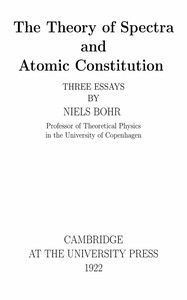
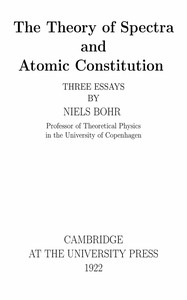
The Theory of Spectra and Atomic Constitution: Three Essays by Niels Bohr

(3 User reviews)   3507
Bohr, Niels, 1885-1962 Bohr, Niels, 1885-1962
English
Ever wonder how we figured out what makes atoms tick? Forget dry textbooks—this is the real story. Niels Bohr, a young physicist, stared at the weird, colorful lines of light that atoms give off (their 'spectra') and realized the rules of our everyday world just didn't apply. The old physics was broken. In these three essays, you watch his mind work in real time as he pieces together a radical new model of the atom, a tiny solar system with strict rules for its electrons. It's a detective story about the universe's smallest building blocks, written by the detective himself.
Share

Read "The Theory of Spectra and Atomic Constitution: Three Essays by Niels Bohr" Online

This book is available in the public domain. Start reading the digital edition below.

START READING FULL BOOK
Instant Access    Mobile Friendly

Book Preview

A short preview of the book’s content is shown below to give you an idea of its style and themes.

_Reasons for annulling the pretended Assembly at_ Linlithgow, 1608. _Reasons for annulling the pretended Assembly at_ Glasgow, 1610. _Reasons for annulling the pretended Assembly at_ Aberdene, 1616. _The nullitie of the pretended Assembly at_ Saint Andrews, 1617. _Reasons for annulling the pretended Assembly, holden at_ Perth, 1618. Act. Sess. 13. December 5. 1638. _Against the unlawfull oaths of intrants._ Act. Sess. 14. December 6. 1638. _Condemning the Service-book, Book of Canons, Book of Ordination, and the high Commission._ _Sentence of deposition and excommunication against Mr._ John Spottiswood, _pretended Archbishop of St._ Andrews; _Mr._ Patrik Lindsay, _pretended Archbishop of_ Glasgow: _Mr._ David Lindsay, _pretended Bishop of_ Edinburgh: _Mr._ Thomas Sidserfe, _pretended Bishop of_ Galloway: _Mr._ John Maxwell, _pretended Bishop of_ Rosse: _Mr._ Walter Whyt-foord, _pretended Bishop of_ Brechen. _Sentence of deposition and excommunication, against_ Mr. Adam Ballantyne, _pretended Bishop of_ Aberdeen, _and Mr. James Wedderburn pretended Bishop of_ Dumblane. _Sentence of deposition against Master_ John Guthry, _pretended Bishop of_ Murray: _Mr._ John Grahame, _pretended Bishop of_ Orknay, _Mr._ James Fairlie, _pretended Bishop of_ Lismoir: _Mr._ Neil Cambell, _pretended Bishop of_ Isles. _Sentence of deposition against Maister_ Alexander Lindsay _pretended Bishop of_ Dunkell. _Sentence of deposition against Master_ John Abernethie _pretended Bishop of_ Cathnes. Act of the Assembly at _Glasgow_, Sess. 16. December 8. 1638. _Declaring Episcopacie to have been abjured by the Confession of Faith_, 1580. _And to be removed out of this Kirk._ Act. Sess. 17. December 10. 1638. _The Assembly at_ Glasgow, _declaring the five Articles of_ Perth _to have been abjured and to bee removed._ Act. Sess. 21. December 17. 1638. Act. Sess. 23, 24. December 17. 18. Act Sess. 14. December 18. 1638. Act. Sess. 25. December 19. 1638. _Against the civil places and power of Kirk-men._ Act Sess. 26. December 20. 1638. Act. Sess. 26. December 20. 1638. Act Sess. 26. December 20. 1638. Act Sess. 26. December 20. Act Sess. 26. December 20. 1638. _Concerning the subscribing the confession of Faith lately subscribed by his Majesties Commissioner, and urged to be subscribed by others._ Act. Sess. 26. December 20. 1638. _Concerning yearly generall Assemblies._ _Ordaining an humble supplication to be sent to the Kings Majestie._ The General Assembly, At Edinburgh, 1639. Sess. 8. August 17. 1639. _Master_ George Grahame _his renouncing and abjuring of Episcopacie._ Sess. 8. August 17. 1639. _Act containing the Causes and Remedie of the by-gone Evils of this Kirk._ Sess. 18. Aug. 26. 1639. _Act approving an old Register of the Generall Assembly._ Act Sess. 19. August 27. 1639. _Act approving the deposition of the Ministers by the Committees._ Act Sess. 20. Aug. 28. 1639. _Act anent receiving of deposed Ministers._ Act Sess. 21. August 29. 1639. _Act anent the keeping of the Lords Day._ Act Sess. 22. Aug. 29. 1639. _a Meridie._ _Articles and Overtures approved by the Assembly._ Sess. 23. August 30. 1639. _The Supplication of the General Assembly to the Kings Majesties Commissioner, concerning the Book, called_, The large Declaration. _The Supplication of the Assembly to His Majesties High Commissioner, and the Lords of secret Councell._ _The Act of the Lords of Councel at_ Edinburgh, August 30. 1639. _containing the_ Answer _of the preceding_ Supplication. _The Kings Majesties Commissioners Declarations._ _Like as his Majesties Commissioner, read and gave in the Declaration following, of his consent to the Act of the Assembly_ 17. August, _anent the causes of our by gone evils._ _Like as His Majesties Commissioner, read and gave in the Declaration following:_ _Act ordaining the subscription of the Confession of Faith and Covenant, with the Assemblies Declaration._ _Act anent Appellations._ _Act anent advising with Synods and Presbyteries...

This is a limited preview. Download the book to read the full content.

This isn't a novel with characters, but the story it tells is one of the great intellectual adventures of the 20th century. The 'plot' is Bohr wrestling with a puzzle: why do atoms only emit light at very specific colors? The old physics couldn't explain it. In these essays, written between 1913 and 1921, Bohr lays out his revolutionary answer. He proposes that electrons orbit the nucleus in fixed, quantized paths and jump between them, releasing precise packets of light. We see his idea evolve from a bold hypothesis to a foundational theory, changing science forever.

Why You Should Read It

Reading Bohr is like getting a backstage pass to a scientific revolution. You see the struggle, the uncertainty, and the sheer creative leap. His writing is clear and methodical, but you can feel the excitement bubbling under the surface. It's not just about the 'what' of atomic theory, but the 'how'—how a brilliant person tackles an impossible problem. It makes you appreciate that these world-changing ideas didn't arrive fully formed; they were built, step by careful step.

Final Verdict

Perfect for curious minds who enjoy history, science, or great stories about problem-solving. You don't need a PhD, just an interest in how we came to understand our world. If you've ever looked at a neon sign and wondered 'how does that work?', this book shows you the moment we started to find the answer. It's for the reader who wants to meet a genius not as a statue, but as a thinker in the middle of his biggest breakthrough.


🔖 No Rights Reserved

There are no legal restrictions on this material. Feel free to use it for personal or commercial purposes.

James Robinson
1 year ago

Great reference material for my coursework.

Thomas Taylor
5 months ago

This is one of those stories where the flow of the text seems very fluid. A true masterpiece.

Elizabeth Torres
3 months ago

Citation worthy content.

5
5 out of 5 (3 User reviews )

Add a Review

Your Rating *
There are no comments for this eBook.
You must log in to post a comment.
Log in


Related eBooks