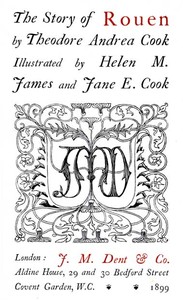
The Story of Rouen by Theodore Andrea Cook

(11 User reviews)   3892
Cook, Theodore Andrea, 1867-1928 Cook, Theodore Andrea, 1867-1928
English
Ever walked through a city and felt the weight of centuries beneath your feet? That's the feeling Theodore Andrea Cook captures in 'The Story of Rouen.' This isn't just a dry history book. It's a guided tour through time, led by someone who's clearly in love with his subject. Cook takes you from the city's ancient beginnings, through the dramatic burning of Joan of Arc, right up to the modern era. He shows you how war, faith, art, and commerce all left their mark on Rouen's streets and buildings. If you've ever wanted to understand how a place becomes more than just a spot on a map, this book is your perfect companion. It turns history into a living, breathing story.
Share

Read "The Story of Rouen by Theodore Andrea Cook" Online

This book is available in the public domain. Start reading the digital edition below.

START READING FULL BOOK
Instant Access    Mobile Friendly

Book Preview

A short preview of the book’s content is shown below to give you an idea of its style and themes.

Author of “The Religious History of the Slavonic Nations,” etc. Second Edition. Edinburgh: Johnstone, Hunter & Co. 1870 CONTENTS Preface. Preface To The Second Edition. Introductory Dissertation. Chapter I. Origin Of The Worship Of Relics And Images In The Christian Church. Chapter II. Compromise Of The Church With Paganism. Chapter III. Position Of The First Christian Emperors Towards Paganism, And Their Policy In This Respect. Chapter IV. Infection Of The Christian Church By Pagan Ideas And Practices During The Fourth And Fifth Centuries. Chapter V. Reaction Against The Worship Of Images And Other Superstitious Practices By The Iconoclast Emperors Of The East. Chapter VI. Origin And Development Of The Pious Legends, Or Lives Of Saints, During The Middle Ages. Chapter VII. Analysis Of The Pagan Rites And Practices Which Have Been Retained By The Roman Catholic As Well As The Græco-Russian Church. Chapter VIII. Image-Worship And Other Superstitious Practices Of The Graeco-Russian Church. Calvin’s Treatise On Relics, With Notes By The Translator. Postscript. List Of Works Published By Johnstone, Hunter, & Co., Edinburgh. Footnotes PREFACE. The Treatise on Relics by the great Reformer of Geneva is not so generally known as it deserves, though at the time of its publication it enjoyed a considerable popularity.(1) The probable reason of this is: the absurdity of the relics described in the Treatise has since the Reformation gradually become so obvious, that their exhibitors make as little noise as possible about their miraculous wares, whose virtues are no longer believed except by the most ignorant part of the population of countries wherein the education of the inferior classes is neglected. And, indeed, not only Protestants, but many enlightened Roman Catholics believed that all the miracles of relics, images, and other superstitions with which Christianity were infected during the times of mediæval ignorance would be soon, by the progress of knowledge, consigned for ever to the oblivion of the dark ages, and only recorded in the history of the aberrations of the human mind, together with the superstitions of ancient Egypt, Greece, and Rome. Unfortunately these hopes have not been realised, and are still remaining amongst the _pia desideria_. The Roman Catholic reaction, which commenced about half a century ago by works of a philosophical nature, adapted to the wants of the most intellectual classes of society, has, emboldened by success, gradually assumed a more and more material tendency, and at length has begun to manifest itself by such results as the exhibition of the holy coat at Treves, which produced a great noise over all Germany,(2) the apparition of the Virgin at La Salette, the winking Madonna of Rimini, and, what is perhaps more important than all, the solemn installation of the relics of St Theodosia at Amiens; whilst works of a description similar to the Life of St Francis of Assisi, by M. Chavin de Malan, and the Lives of the English Saints, which I have mentioned on pp. 113 and 115 of my Introduction are produced by writers of considerable talent and learning. These are significant facts, and prove, at all events, that in spite of the progress of intellect and knowledge, which is the boast of our century, we seem to be fast returning to a state of things similar to the time when Calvin wrote his Treatise. I therefore believe that its reproduction in a new English translation will not be out of date. On the other side, the politico-religious system of aggression followed by Russia has now taken such a rapid development, that the dangers which threaten the liberties and civilization of Europe from that quarter have become...

This is a limited preview. Download the book to read the full content.

If you think history is just a list of dates and dead kings, Theodore Andrea Cook is here to change your mind. In 'The Story of Rouen,' he doesn't just tell you what happened; he shows you where it happened and makes you feel why it mattered.

The Story

Cook walks you through Rouen's entire life, from its muddy start as a Roman settlement to its time as a powerhouse of medieval Normandy. He pauses at all the big moments: the Viking raids, the construction of its stunning cathedral, and of course, the trial and execution of Joan of Arc, which he describes with gripping detail. But he also shows you the quieter history in the half-timbered houses and the bustling old market squares. The book follows the city's story through revolutions, wars, and rebirths, right into the 20th century, painting a complete picture of how a city survives and evolves.

Why You Should Read It

What makes this book special is Cook's voice. He writes with the excitement of a local expert showing you around his hometown. You can tell he's walked every cobblestone he describes. He connects grand political events to the everyday life of the city, making history feel personal and immediate. It’s less like reading a textbook and more like listening to a fantastic storyteller point out all the hidden layers of a place you thought you knew.

Final Verdict

This book is a must-read for travelers with a curiosity about the past, especially if France is on your itinerary. It's also perfect for anyone who loves biographies—but of a city instead of a person. Cook gives Rouen a character all its own, full of drama, beauty, and resilience. You'll finish the book feeling like you've not just learned about a city, but actually visited it.


🟢 Public Domain Content

This masterpiece is free from copyright limitations. It serves as a testament to our shared literary heritage.

Robert Lopez
3 months ago

Comprehensive and well-researched.

Noah Flores
9 months ago

Enjoyed every page.

Daniel Walker
1 year ago

Having read this twice, it challenges the reader's perspective in an intellectual way. Absolutely essential reading.

Ashley Wilson
1 week ago

Five stars!

Oliver Ramirez
6 months ago

I had low expectations initially, however the author's voice is distinct and makes complex topics easy to digest. I will read more from this author.


5
5 out of 5 (11 User reviews )

Add a Review

Your Rating *
There are no comments for this eBook.
You must log in to post a comment.
Log in


Related eBooks