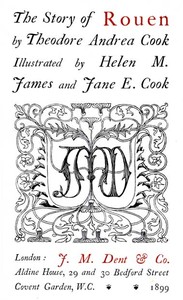
The Story of Rouen by Theodore Andrea Cook

(4 User reviews)   3195
Cook, Theodore Andrea, 1867-1928 Cook, Theodore Andrea, 1867-1928
English
Ever wondered what it's like to walk through a city that's lived a thousand lives? Forget dry history books. Theodore Andrea Cook's 'The Story of Rouen' is like a time machine in your hands. It doesn't just list dates; it brings you right to the cobblestone streets to meet the people who shaped them. You'll feel the clang of Viking axes, hear the whispers of medieval traders, and see the smoke of Joan of Arc's pyre. Cook has this incredible knack for making you feel like you're discovering the city's secrets alongside him. It's less of a history lesson and more of a guided tour from your most enthusiastic, knowledgeable friend.
Share

Read "The Story of Rouen by Theodore Andrea Cook" Online

This book is available in the public domain. Start reading the digital edition below.

START READING FULL BOOK
Instant Access    Mobile Friendly

Book Preview

A short preview of the book’s content is shown below to give you an idea of its style and themes.

small room looking out on a very uninteresting London street. It was about three o’clock on a November afternoon, that season of fogs and rains and mud, when towns-people long for fresh air and hillsides, and country-folk think wistfully of the warmth and lights of a city, when nobody is satisfied, and everybody has a cold. Outside the window of the room there were a few feet of earth adorned with a low bush or two, a line of railings, a stone-paved street, and on the other side a long row of uniform yellow brick houses. The apartment itself was a modest chamber, containing a minimum of rented furniture and a flickering gas-stove. By a small caseful of medical treatises and a conspicuous stethoscope, the least experienced could see that it was labelled consulting-room. Dr Twiddel was enjoying one of those moments of repose that occur even in the youngest practitioner’s existence. For the purposes of this narrative he may briefly be described as an amiable-looking young man, with a little bit of fair moustache and still less chin, no practice to speak of, and a considerable quantity of unpaid bills. A man of such features and in such circumstances invites temptation. At the present moment, though his waistcoat was unbuttoned and his feet rested on the mantelpiece, his mind seemed not quite at ease. He looked back upon a number of fortunate events that had not occurred, and forward to various unpleasant things that might occur, and then he took a letter from his pocket and read it abstractedly. “I can’t afford to refuse,” he reflected, lugubriously; “and yet, hang it! I must say I don’t fancy the job.” When metal is molten it can be poured into any vessel; and at that moment a certain deep receptacle stood on the very doorstep. The doctor heard the bell, sat up briskly, stuffed the letter back into his pocket, and buttoned his waistcoat. “A patient at last!” and instantly there arose a vision of a simple operation, a fabulous fee, and twelve sickly millionaires an hour ever after. The door opened, and a loud voice hailed him familiarly. “Only Welsh,” he sighed, and the vision went the way of all the others. The gentleman who swaggered in and clapped the doctor on the back, who next threw himself into the easiest chair and his hat and coat over the table, was in fact Mr Robert Welsh. From the moment he entered he pervaded the room; the stethoscope seemed to grow less conspicuous, Dr Twiddel’s chin more diminutive, the apartment itself a mere background to this guest. Why? It would be hard to say precisely. He was a black-moustached, full-faced man, with an air of the most consummate assurance, and a person by some deemed handsome. Yet somehow or other he inevitably recalled the uncles of history. Perhaps this assurance alone gave him his atmosphere. You could have felt his egotism in the dark. He talked in a loud voice and with a great air of mastery over all the contingencies of a life about town. You felt that here sat one who had seen the world and gave things their proper proportions, who had learned how meretricious was orthodoxy, and which bars could really be recommended. He chaffed, patronised, and cheered the doctor. Patients had been scarce, had they? Well, after all, there were many consolations. Did Twiddle say he was hard up? Welsh himself in an even more evil case. He narrated various unfortunate transactions connected with the turf and other pursuits, with regret, no doubt, and yet with...

This is a limited preview. Download the book to read the full content.

If you're picturing a dusty timeline of French kings and battles, think again. Theodore Andrea Cook's book is something much more alive.

The Story

This isn't a story with a single hero or villain. The main character is Rouen itself. Cook takes you on a journey through the city's entire life, from its ancient Roman roots to the modern era of his own time. He shows you how the city grew from a small settlement into a powerhouse of medieval trade and a key player in English and French history. You'll see it through Viking raids, the drama of the Hundred Years' War, and its rebirth during the Renaissance. The book is built around the idea that a city's soul is found in its streets, its buildings, and the everyday lives of its people across centuries.

Why You Should Read It

Cook's passion is contagious. He doesn't just tell you what happened; he makes you see and feel it. His descriptions of the towering Gothic cathedral or the old market square are so vivid you can almost smell the air. He has a special focus on architecture and art, showing how the city's changing fortunes were literally carved into stone. What I loved most was how he connected grand historical events to the physical places you could still visit. It turns history from abstract facts into a tangible, walkable experience.

Final Verdict

This book is perfect for anyone who loves to travel, even if it's just from their armchair. It's for the reader who visits a city and immediately wants to know, 'What happened here?' History fans will appreciate the rich detail, but you don't need a degree to enjoy it. Cook writes with such warmth and clarity that he makes centuries of complex history not just understandable, but genuinely exciting. Just be warned: you'll probably start looking up flights to Normandy by the last chapter.


📚 No Rights Reserved

This digital edition is based on a public domain text. Thank you for supporting open literature.

Edward Thompson
2 months ago

My professor recommended this, and I see why.

William Wilson
1 year ago

Based on the summary, I decided to read it and the plot twists are genuinely surprising. I will read more from this author.

Margaret Nguyen
6 months ago

Surprisingly enough, the clarity of the writing makes this accessible. Exactly what I needed.

Margaret Davis
8 months ago

Without a doubt, the storytelling feels authentic and emotionally grounded. Don't hesitate to start reading.

5
5 out of 5 (4 User reviews )

Add a Review

Your Rating *
There are no comments for this eBook.
You must log in to post a comment.
Log in


Related eBooks