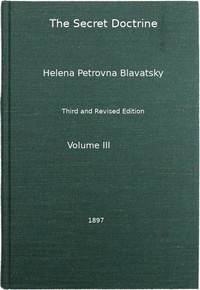
The Secret Doctrine, Vol. 3 of 4 by H. P. Blavatsky

(2 User reviews)   2496
By Charlotte Girard Posted on Dec 26, 2025
In Category - Philosophy
Blavatsky, H. P. (Helena Petrovna), 1831-1891 Blavatsky, H. P. (Helena Petrovna), 1831-1891
English
Ever feel like history and religion are missing huge pieces? Helena Blavatsky thought so too. 'The Secret Doctrine, Vol. 3' is her deep dive into the hidden roots of everything—from ancient myths and lost civilizations to the real story behind world religions. It's not a light read; it's a mind-bending puzzle that challenges everything you thought you knew. She connects dots between Sanskrit texts, Egyptian symbols, and Christian stories in ways that will either make your head spin or blow it wide open. If you're curious about the 'why' behind our oldest stories and aren't afraid of a challenging, controversial text, this is a wild ride into the unseen foundations of human belief.
Share

Read "The Secret Doctrine, Vol. 3 of 4 by H. P. Blavatsky" Online

This book is available in the public domain. Start reading the digital edition below.

START READING FULL BOOK
Instant Access    Mobile Friendly

Book Preview

A short preview of the book’s content is shown below to give you an idea of its style and themes.

Section XI. The Hexagon with the Central Point, or the Seventh Key. Section XII. The Duty of the True Occultist toward Religions. Section XIII. Post‐Christian Adepts and their Doctrines. Section XIV. Simon and his Biographer Hippolytus. Section XV. St. Paul the real Founder of present Christianity. Section XVI. Peter a Jewish Kabalist, not an Initiate. Section XVII. Apollonius of Tyana. Section XVIII. Facts underlying Adept Biographies. Section XIX. St. Cyprian of Antioch. Section XX. The Eastern Gupta Vidya & the Kabalah. Section XXI. Hebrew Allegories. Section XXII. The “Zohar” on Creation and the Elohim. Section XXIII. What the Occultists and Kabalists have to say. Section XXIV. Modern Kabalists in Science and Occult Astronomy. Section XXV. Eastern and Western Occultism. Section XXVI. The Idols and the Teraphim. Section XXVII. Egyptian Magic. Section XXVIII. The Origin of the Mysteries. Section XXIX. The Trial of the Sun Initiate. Section XXX. The Mystery “Sun of Initiation.” Section XXXI. The Objects of the Mysteries. Section XXXII. Traces of the Mysteries. Section XXXIII. The Last of the Mysteries in Europe. Section XXXIV. The Post‐Christian Successors to the Mysteries. Section XXXV. Symbolism of Sun and Stars. Section XXXVI. Pagan Sidereal Worship, or Astrology. Section XXXVII. The Souls of the Stars—Universal Heliolatry. Section XXXVIII. Astrology and Astrolatry. Section XXXIX. Cycles and Avataras. Section XL. Secret Cycles. Section XLI. The Doctrine of Avataras. Section XLII. The Seven Principles. Section XLIII. The Mystery of Buddha. Section XLIV. “Reincarnations” of Buddha. Section XLV. An Unpublished Discourse of Buddha. Section XLVI. Nirvana‐Moksha. Section XLVII. The Secret Books of “Lam‐Rin” and Dzyan. Section XLVIII. Amita Buddha Kwan‐Shai‐yin, and Kwan‐yin.—What the “Book of Dzyan” and the Lamaseries of Tsong‐Kha‐pa say. Section XLIX. Tsong‐Kha‐pa.—Lohans in China. Section L. A few more Misconceptions Corrected. Section LI. The “Doctrine of the Eye” & the “Doctrine of the Heart,” or the “Heart’s Seal.” Some Papers On The Bearing Of Occult Philosophy On Life. Paper I. A Warning. Paper II. An Explanation. Paper III. A Word Concerning the Earlier Papers. Appendix. Notes on Papers I., II. and III. Notes On Some Oral Teachings. Footnotes [Cover Art] [Transcriber’s Note: The above cover image was produced by the submitter at Distributed Proofreaders, and is being placed into the public domain.] As for what thou hearest others say, who persuade the many that the soul when once freed from the body neither suffers ... evil nor is conscious, I know that thou art better grounded in the doctrines received by us from our ancestors and in the sacred orgies of Dionysus than to believe them; for the mystic symbols are well known to us who belong to the Brotherhood. PLUTARCH. The problem of life is man. Magic, or rather Wisdom, is the evolved knowledge of the potencies of man’s interior being, which forces are divine emanations, as intuition is the perception of their origin, and initiation our induction into that knowledge.... We begin with instinct; the end is omniscience. A. WILDER. PREFACE. The task of preparing this volume for the press has been a difficult and anxious one, and it is necessary to state clearly what has been done. The papers given to me by H. P. B. were quite unarranged, and had no obvious order: I have, therefore, taken each paper as a separate Section, and have arranged them as sequentially as possible. With the exception of the correction of grammatical errors and the elimination of obviously un‐ English idioms, the papers are as H. P. B. left them, save as otherwise marked. In a few cases I have filled in a gap, but any such addition is enclosed within square...

This is a limited preview. Download the book to read the full content.

Let's be clear: this isn't a novel with a plot. Think of it as an intellectual excavation. Helena Blavatsky, founder of the Theosophical Society, acts as your guide through a dense forest of ancient texts, symbols, and philosophies. In this volume, she pulls together threads from Hinduism, Buddhism, Kabbalah, and more, arguing they all point to a single, ancient wisdom that predates and underpins all modern religion and science. She's trying to reconstruct a lost history of human spiritual development.

Why You Should Read It

You read this for the sheer audacity of it. Blavatsky's central idea—that a 'Secret Doctrine' unites all spiritual thought—is compelling, even when her evidence feels like a stretch. It's like watching a brilliant, unorthodox detective solve the world's biggest cold case. The connections she makes between, say, a Buddhist sutra and a Gnostic text are fascinating. It forces you to look at familiar stories in a completely new light. It's less about agreeing with every point and more about enjoying the wild, panoramic view of human belief she paints.

Final Verdict

This book is for the intellectually adventurous. Perfect for anyone who loves comparative mythology, the history of ideas, or alternative spiritual frameworks. It's definitely not for someone seeking a simple, straightforward guide—it's complex, dense, and often controversial. But if you enjoy books that challenge the official narrative and make you think deeply about where our deepest beliefs come from, grab a copy and prepare for a journey into the weird and wonderful basement of human consciousness.


📢 Legal Disclaimer

This book is widely considered to be in the public domain. Use this text in your own projects freely.

Brian Davis
4 months ago

Great read!

Thomas Young
1 year ago

Amazing book.

5
5 out of 5 (2 User reviews )

Add a Review

Your Rating *
There are no comments for this eBook.
You must log in to post a comment.
Log in


Related eBooks