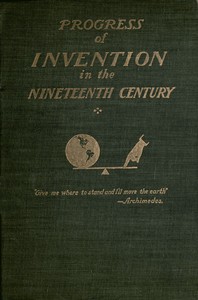
The Progress of Invention in the Nineteenth Century. by Edward W. Byrn

(4 User reviews)   3594
Byrn, Edward W. (Edward Wright), 1849-1921 Byrn, Edward W. (Edward Wright), 1849-1921
English
Hey, I just read this amazing book that's basically a time capsule of human genius. It's called 'The Progress of Invention in the Nineteenth Century,' and it's not a dry history lesson. It's the story of how everyday life was completely reinvented in just 100 years. The book walks you through the wild chain reactions—how one crazy idea for a steam engine leads to trains, which changes how we farm, which leads to new food, and suddenly the whole world is connected. It makes you realize that the phone in your pocket and the lights in your house all started with someone tinkering in a shed. If you've ever wondered 'how did we get here?' this is your answer. It's genuinely thrilling to see the puzzle pieces click into place.
Share

Read "The Progress of Invention in the Nineteenth Century. by Edward W. Byrn" Online

This book is available in the public domain. Start reading the digital edition below.

START READING FULL BOOK
Instant Access    Mobile Friendly

Book Preview

A short preview of the book’s content is shown below to give you an idea of its style and themes.

More Transcriber’s notes have been added at the end of the text. [Illustration: STEAM AND ELECTRICITY. The 70,000 Horse-Power Station of the Metropolitan Street Railway, New York.] THE PROGRESS OF INVENTION IN THE NINETEENTH CENTURY BY EDWARD W. BYRN, A.M. “Δός που στω, και την γην κινἡσω.” (Give me where to stand, and I’ll move the earth.) --_Archimedes._ MUNN & CO., PUBLISHERS SCIENTIFIC AMERICAN OFFICE 361 BROADWAY, NEW YORK 1900 COPYRIGHTED, 1900, BY MUNN & CO. ENTERED AT STATIONER’S HALL LONDON, ENGLAND ALL RIGHTS RESERVED Printed in the United States of America by The Manufacturers’ and Publishers’ Printing Company, New York City. PREFACE. For a work of such scope as this, the first word of the author should be an apology for what is doubtless the too ambitious effort of a single writer. A quarter of a century in the high tide of the arts and sciences, an ardent interest in all things that make for scientific progress, and the aid and encouragement of many friends in and about the Patent Office, furnish the explanation. The work cannot claim the authority of a text-book, the fullness of a history, nor the exactness of a technical treatise. It is simply a cursory view of the century in the field of invention, intended to present the broader bird’s-eye view of progress achieved. In substantiation of the main facts reliance has been placed chiefly upon patents, which for historic development are believed to be the best of all authorities, because they carry the responsibility of the National Government as to dates, and the attested signature and oath of the inventor as to subject matter. Many difficulties and embarrassments have been encountered in the work. The fear of extending it into a too bulky volume has excluded treatment of many subjects which the author recognizes as important, and issues in dispute as to the claims of inventors have also presented themselves in perplexing conflict. A discussion of the latter has been avoided as far as possible, the paramount object being to do justice to all the worthy workers in this field, with favor to none, and only expressing such conclusions as seem to be justified by authenticated facts and the impartial verdict of reason in the clearing atmosphere of time. For sins of omission a lack of space affords a reasonable excuse, and for those of commission the great scope of the work is pleaded in extenuation. It is hoped, however, that the volume may find an accepted place in the literature of the day, as presenting in compact form some comprehensive and coherent idea of the great things in invention which the Nineteenth Century has added to the world’s wealth of ideas and material resources. In acknowledging the many obligations to friends who have aided me in the work, my thanks are due first to the Editors of the _Scientific American_ for aid rendered in the preparation of the work; also to courteous officials in the Government Departments, and to many progressive manufacturers throughout the country. E. W. B. _Washington, D. C., October, 1900._ TABLE OF CONTENTS. CHAPTER I. THE PERSPECTIVE VIEW. CHAPTER II. CHRONOLOGY OF LEADING INVENTIONS OF THE NINETEENTH CENTURY. CHAPTER III. THE ELECTRIC TELEGRAPH. The Voltaic Pile. Daniell’s Battery. Use of Conducting Wire by Weber. Steinheil Employs Earth as Return Circuit. Prof. Henry’s Electro- Magnet, and First Telegraphic Experiment. Prof. Morse’s Telegraphic Code and Register. First Line Between Washington and Baltimore. Bain’s Chemical Telegraph. Gintl’s Duplex Telegraph. Edison’s Quadruplex. House’s Printing Telegraph. Fac Simile Telegraphs. Channing and Farmer Fire Alarm. Telegraphing by Induction. Wireless Telegraphy by Marconi. Statistics. CHAPTER IV....

This is a limited preview. Download the book to read the full content.

Forget the boring title for a second. This book is an adventure story, but the heroes are inventors and the treasure is the modern world. Edward W. Byrn doesn't just list facts; he connects the dots. He shows you how the 1800s were one giant, chaotic, brilliant domino effect.

The Story

There isn't a single plot, but there is a powerful narrative arc. Byrn takes you year by year through the century, highlighting the key inventions that changed everything. He starts with things like the telegraph and the photograph, moves through the revolution of steel and electricity, and lands at the dawn of the automobile and wireless communication. He explains not just what was invented, but why it mattered—how the sewing machine freed up time, how the refrigerator changed what we could eat, and how the railroad shrank the planet.

Why You Should Read It

What I loved most was the sense of wonder. Reading this, you feel the collective 'Aha!' moment of an entire century. Byrn has a knack for making complex ideas simple. You get a real sense of the people behind the patents—their failures, their rivalries, and their sudden breakthroughs. It’s incredibly grounding. It reminds you that progress isn't magic; it's messy, often accidental, and built step-by-step by curious people.

Final Verdict

Perfect for curious minds who aren't necessarily science experts. If you enjoy podcasts like '99% Invisible' or wonder about the origin of ordinary things, you'll devour this. It's also a great pick for anyone who feels overwhelmed by today's tech pace; this book is a comforting reminder that every generation has faced dizzying change, and human ingenuity always finds a way. A truly inspiring read that makes you look at your everyday surroundings with new eyes.


🏛️ Usage Rights

This book is widely considered to be in the public domain. You do not need permission to reproduce this work.

Liam Wright
1 year ago

Beautifully written.

Ethan Lee
1 year ago

Five stars!

Emma Scott
1 year ago

Simply put, the pacing is just right, keeping you engaged. I couldn't put it down.

Andrew Clark
1 year ago

As someone who reads a lot, the emotional weight of the story is balanced perfectly. Highly recommended.

5
5 out of 5 (4 User reviews )

Add a Review

Your Rating *
There are no comments for this eBook.
You must log in to post a comment.
Log in


Related eBooks