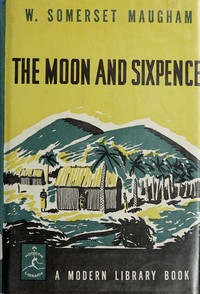
The Moon and Sixpence by W. Somerset Maugham

(6 User reviews)   2766
By Charlotte Girard Posted on Dec 26, 2025
In Category - Philosophy
Maugham, W. Somerset (William Somerset), 1874-1965 Maugham, W. Somerset (William Somerset), 1874-1965
English
Imagine a successful London stockbroker who seems to have it all—a comfortable life, a nice family, social standing. Then one day, he vanishes. Not for another woman or a business scheme, but to become a painter in Paris. That’s the wild setup of 'The Moon and Sixpence.' It’s not a cozy artist story. It’s about a man who abandons everything, treating people horribly along the way, all for this burning, selfish need to create art. The real mystery isn't *if* he’ll find success, but whether his genius excuses the wreckage he leaves behind. It’s a fascinating, infuriating, and unforgettable character study.
Share

Read "The Moon and Sixpence by W. Somerset Maugham" Online

This book is available in the public domain. Start reading the digital edition below.

START READING FULL BOOK
Instant Access    Mobile Friendly

Book Preview

A short preview of the book’s content is shown below to give you an idea of its style and themes.

best show his appreciation of their works by silence and a cheque-book. It is a grotesque misapprehension which sees in art no more than a craft comprehensible perfectly only to the craftsman: art is a manifestation of emotion, and emotion speaks a language that all may understand. But I will allow that the critic who has not a practical knowledge of technique is seldom able to say anything on the subject of real value, and my ignorance of painting is extreme. Fortunately, there is no need for me to risk the adventure, since my friend, Mr. Edward Leggatt, an able writer as well as an admirable painter, has exhaustively discussed Charles Strickland’s work in a little book[1] which is a charming example of a style, for the most part, less happily cultivated in England than in France. [1] “A Modern Artist: Notes on the Work of Charles Strickland,” by Edward Leggatt, A.R.H.A. Martin Secker, 1917. Maurice Huret in his famous article gave an outline of Charles Strickland’s life which was well calculated to whet the appetites of the inquiring. With his disinterested passion for art, he had a real desire to call the attention of the wise to a talent which was in the highest degree original; but he was too good a journalist to be unaware that the “human interest” would enable him more easily to effect his purpose. And when such as had come in contact with Strickland in the past, writers who had known him in London, painters who had met him in the cafés of Montmartre, discovered to their amazement that where they had seen but an unsuccessful artist, like another, authentic genius had rubbed shoulders with them there began to appear in the magazines of France and America a succession of articles, the reminiscences of one, the appreciation of another, which added to Strickland’s notoriety, and fed without satisfying the curiosity of the public. The subject was grateful, and the industrious Weitbrecht-Rotholz in his imposing monograph[2] has been able to give a remarkable list of authorities. [2] “Karl Strickland: sein Leben und seine Kunst,” by Hugo Weitbrecht-Rotholz, Ph.D. Schwingel und Hanisch. Leipzig, 1914. The faculty for myth is innate in the human race. It seizes with avidity upon any incidents, surprising or mysterious, in the career of those who have at all distinguished themselves from their fellows, and invents a legend to which it then attaches a fanatical belief. It is the protest of romance against the commonplace of life. The incidents of the legend become the hero’s surest passport to immortality. The ironic philosopher reflects with a smile that Sir Walter Raleigh is more safely inshrined in the memory of mankind because he set his cloak for the Virgin Queen to walk on than because he carried the English name to undiscovered countries. Charles Strickland lived obscurely. He made enemies rather than friends. It is not strange, then, that those who wrote of him should have eked out their scanty recollections with a lively fancy, and it is evident that there was enough in the little that was known of him to give opportunity to the romantic scribe; there was much in his life which was strange and terrible, in his character something outrageous, and in his fate not a little that was pathetic. In due course a legend arose of such circumstantiality that the wise historian would hesitate to attack it. But a wise historian is precisely what the Rev. Robert Strickland is not. He wrote his biography[3] avowedly to “remove certain misconceptions which had gained currency” in regard to the later part...

This is a limited preview. Download the book to read the full content.

W. Somerset Maugham's The Moon and Sixpence is loosely inspired by the life of painter Paul Gauguin, but it carves out its own brutal and compelling story.

The Story

The narrator, a writer, pieces together the life of Charles Strickland. Strickland is a dull, middle-aged broker who shocks everyone by leaving his wife and children in London to paint in Paris. He lives in poverty, shows no remorse, and is often cruel to those who try to help him, including a fellow artist whose life he ruins. The story follows his journey to Tahiti, where, removed from society, he finally paints with a raw, obsessive power, creating masterpieces while his own health fails.

Why You Should Read It

This book gets under your skin. Strickland is one of the most compellingly awful characters in literature—you'll likely hate him, but you won't be able to look away. Maugham doesn't ask you to like him; he asks you to understand the terrifying force of an uncompromising creative drive. It makes you ask tough questions: What price is too high for genius? Can great art come from a truly terrible person? There are no easy answers here, just brilliant, uncomfortable probing.

Final Verdict

Perfect for anyone who loves a complex, morally gray character that sparks debate. If you enjoy stories about the cost of obsession and the messy line between artistic brilliance and human decency, you'll devour this. It's not a feel-good read, but it’s a powerful one that sticks with you long after the last page.


🟢 Usage Rights

This work has been identified as being free of known copyright restrictions. It is now common property for all to enjoy.

Lisa Rodriguez
11 months ago

Amazing book.

Emily Smith
11 months ago

Solid story.

Linda Hill
1 year ago

This book was worth my time since the content flows smoothly from one chapter to the next. I will read more from this author.

Sandra Anderson
6 months ago

Simply put, the character development leaves a lasting impact. A valuable addition to my collection.

Thomas Martin
1 year ago

I stumbled upon this title and it manages to explain difficult concepts in plain English. I learned so much from this.

5
5 out of 5 (6 User reviews )

Add a Review

Your Rating *
There are no comments for this eBook.
You must log in to post a comment.
Log in


Related eBooks