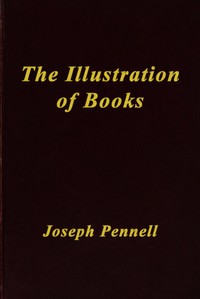
The Illustration of Books by Joseph Pennell

(2 User reviews)   1469
Pennell, Joseph, 1857-1926 Pennell, Joseph, 1857-1926
English
Okay, hear me out. You know that feeling when you look at an old book illustration and just wonder, 'How on earth did they do that?' This isn't a dry history lesson. It's Joseph Pennell, one of the giants of illustration, grabbing you by the collar and pulling you into his workshop. He's arguing with critics, defending his craft, and showing you the sweat and ink behind every perfect line. It’s a passionate, sometimes grumpy, masterclass from 1905 that feels like it was written yesterday. If you love art, books, or just great stories about creative people fighting for their vision, you need this.
Share

Read "The Illustration of Books by Joseph Pennell" Online

This book is available in the public domain. Start reading the digital edition below.

START READING FULL BOOK
Instant Access    Mobile Friendly

Book Preview

A short preview of the book’s content is shown below to give you an idea of its style and themes.

requirements and absolute necessities are evident all around us. The book, therefore, might rather be described as a series of tips or hints--to put it on as low a plane as possible--the result of practical experience, which should enable the student to make his drawings so that they will produce a good effect on the printed page; but, first of all, he must be able to make the drawing well. No one can teach him that; but he can be taught what materials he should use, where he can get them, and how he should employ them. That is all I have tried to do. As I have said in this book repeatedly, processes are discovered and perfected almost daily. Since these lectures were last given, the method of etching zinc and copper half-tone blocks has been entirely revolutionised. Now, there is no inking up of plates; the photograph on the metal serves as a protecting and acid-resisting ground, and the biting is done as simply as in ordinary etching; though, of course, it is the lines or dots which are left in relief. Possibly before the book is out, even greater improvements and developments may be made. Nor have I attempted to describe all the tricks, dodges, and clever schemes employed in newspaper offices for making blocks from photographs, or for the rapid reproduction of sketches, such as drawing on lithographic transfer paper, making photographic enlargements on fugitive prints. All are most useful and valuable in their way, but not exactly what one would tell a student to do. If he becomes an illustrator he will learn these things fast enough. As the book is passing through the press Mr. W. Lewis Fraser, the art manager of "The Century" magazine, writes me that he thinks it "a good practical book, likely to be of much use to the young illustrator, and save the art editor many a pang and many a sorrow." I hope so, and it is with this hope that the book is published. JOSEPH PENNELL. London, _Oct., 1895_. THE ILLUSTRATION OF BOOKS. LECTURE I. _WHAT IS ILLUSTRATION?_ The craving for pictures, that is, for illustrations, is as old as the world. The cave-dweller felt it when he scratched on the walls of his house, or carved the handle of his battle-axe; one there was "who stayed by the tents with the women, and traced strange devices with a burnt stick upon the ground." Others painted themselves blue, and were beautiful; and these were the first illustrators. The Egyptians were the most prolific, and their works may be found, monuments more durable than brass, not alone in their places, but scattered to all the corners of the earth. From the Egyptians and the Assyrians we may skip, offending but the archæologist and the pedant, to the illuminators who threw their light on the Dark Ages. They changed their methods from carving to tracing, and their mediums from stone and papyrus to parchment and vellum. But always these illustrations were single works of art, they were not reproduced, and only duplicated by copying by hand. Beautiful as are the manuscripts, they play but a small and unimportant part in the history of illustration, when compared with the block books that follow them; though block printing is but a natural evolution from the stamp on the bricks of the Egyptian, or the painting on the vases of the Etruscan. The block books, more often loose sheets, were printed from designs, picture and text, cut on the wood, in one piece, sometimes possibly engraved in metal. These blocks, being inked,...

This is a limited preview. Download the book to read the full content.

Forget dusty art theory. The Illustration of Books is Joseph Pennell in full, fiery lecture mode. Published in 1905, it's less a textbook and more a manifesto from a working artist at the top of his game. Pennell takes you through the entire world of book illustration, from wood engraving and etching to lithography, but he does it by sharing opinions, trade secrets, and plenty of strong arguments.

The Story

There isn't a plot in the traditional sense. Instead, Pennell builds his case chapter by chapter. He champions the illustrator as a true artist, not just a decorator. He argues fiercely for the importance of technique, materials, and the artist's direct hand in the reproduction process. He critiques the state of publishing, praises the masters he admires, and doesn't hold back on what he thinks is mediocre. The "story" is the journey of his passionate defense of an art form.

Why You Should Read It

You get a front-row seat to a brilliant mind. Pennell's voice is incredibly engaging—he's witty, sarcastic, and deeply knowledgeable. Reading this is like having coffee with a grumpy but brilliant professor who loves his job. You learn not just *how* illustrations were made, but *why* certain choices matter. His frustration with poor printing or lazy design feels surprisingly modern. It makes you look at every illustrated book on your shelf with new, appreciative eyes.

Final Verdict

Perfect for artists, illustrators, and graphic designers who want a dose of historical perspective and timeless wisdom. It's also a gem for book lovers and history buffs curious about the "how" behind beautiful old books. If you enjoy passionate, opinionated non-fiction where the author's personality jumps off the page, you'll be hooked. Just be ready for some strong, early-1900s opinions!


🟢 Copyright Free

This historical work is free of copyright protections. It is available for public use and education.

Sandra Wright
10 months ago

Very helpful, thanks.

Kevin Thompson
4 months ago

Great reference material for my coursework.
5
5 out of 5 (2 User reviews )

Add a Review

Your Rating *
There are no comments for this eBook.
You must log in to post a comment.
Log in


Related eBooks