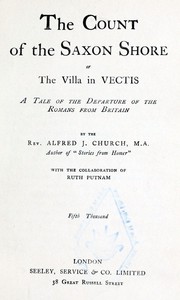
The Count of the Saxon Shore; or The Villa in Vectis. by Church and Putnam

(3 User reviews)   2347
By Charlotte Girard Posted on Nov 15, 2025
In Category - Philosophy
Putnam, Ruth, 1856-1931 Putnam, Ruth, 1856-1931
English
Ever wondered what happened after the Romans packed up and left Britain? 'The Count of the Saxon Shore' isn't just about crumbling villas and forgotten forts. It's about a young man, Valens, who inherits a crumbling estate on the Isle of Wight (Vectis) just as the world he knows is falling apart. The real empire is gone, but new threats—Saxon raiders—are sailing to shore. This is a story about holding onto home when everything is changing, and figuring out what you're willing to fight for when the old rules don't apply anymore. It's surprisingly fresh historical fiction that feels less like a dusty lesson and more like a personal struggle you can root for.
Share

Read "The Count of the Saxon Shore; or The Villa in Vectis. by Church and Putnam" Online

This book is available in the public domain. Start reading the digital edition below.

START READING FULL BOOK
Instant Access    Mobile Friendly

Book Preview

A short preview of the book’s content is shown below to give you an idea of its style and themes.

were representatives of every province of the Empire, Italy only excepted. They had been just receiving their pay, long in arrear, and now considerably short of the proper amount, and containing not a few coins which the receivers seemed to think of doubtful value. “Let me look at his Imperial Majesty,” said another speaker; and he scanned the features of the new Cæsar—features never very dignified, and certainly not flattered by the rude coinage—with something like contempt. “Well, he does not look exactly as a Cæsar should; but what does it matter? This will go down with Rufus at the wine-shop and Priscus the sausage-seller, as well as the head of the great Augustus himself.” “Ah!” said a third speaker, picking out from a handful of silver a coin which bore the head of Theodosius, “this was an Emperor worth fighting under. I made my first campaign with him against Maximus, another British Cæsar, by the way; and he was every inch a soldier. If his son were like him(3) things would be smoother than they are.” “Do you think,” said the second speaker, after first throwing a cautious glance to see whether any officer of rank was in hearing—“do you think we have made a change for the better from Marcus?(4) He at all events used to be more liberal with his money than his present majesty. You remember he gave us ten silver pieces each. Now we don’t even get our proper pay.” “Marcus, my dear fellow,” said the other speaker, “had a full military chest to draw upon, and it was not difficult to be generous. Gratianus has to squeeze every denarius out of the citizens. I heard them say, when the money came into the camp yesterday, that it was a loan from the Londinium merchants. I wonder what interest they will get, and when they will see the principal again.” “Hang the fat rascals!” said the other. “Why should they sleep soft, and eat and drink the best of everything, while we poor soldiers, who keep them and their money-bags safe, have to go bare and hungry?” “Come, come, comrades,” interrupted the first soldier who had spoken; “no more grumbling, or some of us will find the centurion after us with his vine-sticks.” The group broke up, most of them making the best of their way to spend some of their unaccustomed riches at the wine-shop, a place from which they had lately kept an enforced absence. Three or four of the number, however, who seemed, from a sign that passed between them, to have some secret understanding, remained in close conversation—a conversation which they carried on in undertones, and which they adjourned to one of the tents to finish without risk of being disturbed or overheard. The camp in which our story opens was a square enclosure, measuring some five hundred yards each way, and surrounded by a massive wall, not less than four feet in thickness, in the construction of which stone, brick, and tile had, in Roman fashion, been used together. The defences were completed by strong towers of a rounded shape, which had been erected at frequent intervals. The camp had, as usual, its four gates. That which opened upon the sea—for the sea washed the southern front—was famous in military tradition as the gate by which the second legion had embarked to take part in the Jewish War and the famous siege of Jerusalem. Vespasian, who had begun in Britain the great career which ended in the throne, had experienced its valour and discipline in more than one campaign,(5) and...

This is a limited preview. Download the book to read the full content.

Okay, let's set the scene: It's the late 4th century AD. The Roman Empire is overstretched and starting to pull its legions back from far-flung places like Britain. This leaves places like the Isle of Wight—or Vectis, as it was called—pretty exposed.

The Story

We follow Valens, a young Roman-British noble who unexpectedly becomes the new 'Count of the Saxon Shore,' a military title responsible for defending the coast. His new home base? A lonely, run-down villa on Vectis. The job is huge: with few soldiers and even less support from a fading empire, he has to protect his people from Saxon pirates who see the undefended coast as an open invitation. The story is really about Valens growing into this impossible role, trying to bridge the old Roman world and the new British reality, all while figuring out who his real allies are.

Why You Should Read It

What grabbed me was how personal it all feels. This isn't a grand saga of emperors and epic battles (though there is some great tension). It's about a guy trying to fix a leaky roof, manage stubborn locals, and muster a defense with whatever he can scrape together. The history isn't just backdrop; it's the daily problem. You feel the isolation of the villa and the weight of Valens's responsibility. Ruth Putnam makes this distant, shadowy period of history—often called the 'Dark Ages'—feel immediate and human.

Final Verdict

Perfect for anyone who likes historical fiction but is tired of the same old Tudor or World War II settings. If you enjoy stories about underdogs, community, and the messy work of building something new from the pieces of the old, you'll find a lot to love here. It's a quiet, thoughtful adventure more about stewardship than conquest, and it offers a fascinating glimpse into a time of massive change that history books often skip over.


📚 Legal Disclaimer

The copyright for this book has expired, making it public property. Access is open to everyone around the world.

Mary Martin
2 weeks ago

After finishing this book, the atmosphere created is totally immersive. I couldn't put it down.

Kimberly Anderson
1 year ago

Citation worthy content.

Deborah Wilson
1 year ago

Clear and concise.

5
5 out of 5 (3 User reviews )

Add a Review

Your Rating *
There are no comments for this eBook.
You must log in to post a comment.
Log in


Related eBooks