1

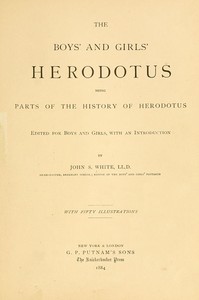
The Boys' and Girls' Herodotus Being Parts of the History of Herodotus, Edited for Boys and Girls — Story, Setting & Ideas
(0 User reviews)
402
Project Gutenberg
2017
Not confirmed
History, Ancient -- Juvenile literature; Greece -- History -- Persian Wars, 500-449 B.C. -- Juvenile literature; Greece -- History -- To 146 B.C. -- Juvenile literature
Readers of public-domain and historical texts
Project Gutenberg digital edition
en
Edition facts
Words
115,826
Reading time
504 min
Text sections
21
Before opening The Boys' and Girls' Herodotus Being Parts of the History of Herodotus, Edited for Boys and Girls — Story, Setting & Ideas, the edition data offers a quick orientation: 115,826 words, 8 hr 24 min estimated reading time, and 21 detected text sections.
The text analysis averages about 32.4 words per sentence, while the detected sections provide another way to judge how the source is divided.
Project Gutenberg metadata also associates the work with “History, Ancient -- Juvenile literature,” connecting these edition facts with the source record’s subject description.
Source:
Project Gutenberg record #55758
This edition of Herodotus, edited by John S. White for young readers, selects episodes from the Histories with an emphasis on narrative clarity and moral exempla. White's introduction frames the historian as a master prose stylist, while the text retains Herodotus's distinctive voice—a blend of ethnographic curiosity, direct speech, and catalogues of tribute and custom.
Read the complete public-domain text at its original source.
Read on Project GutenbergJohn S. White's 1884 edition of Herodotus for young readers opens with a vivid tableau: Athens in 446 B.C., a city past its political zenith but still the intellectual Mecca of the Greek world. White imagines a young Herodotus, recently arrived from Halicarnassus, reading his history aloud to enthralled audiences—a scene that establishes the editor's reverence for the historian's prose. The excerpts show White preserving Herodotus's characteristic blend of direct speech, ethnographic detail, and moral commentary, as when the Persians describe Cyrus as a father, Cambyses as a master, and Darius as a trader. This editorial note examines the authorial choices visible in diction, dialogue, and description, focusing on how White's selections shape the reader's encounter with Herodotus's voice.
Direct Speech and Character Judgment
Herodotus frequently embeds character assessments in reported speech, a technique White retains. In the excerpt on Persian kings, the Persians themselves characterize Cyrus as mild and fatherly, Cambyses as severe and arrogant, and Darius as a trader who profited from everything. This indirect characterization through attributed speech allows Herodotus to present multiple perspectives without overt authorial judgment. White's edition preserves these layered voices, letting young readers infer the moral qualities of rulers from what others say about them. The effect is a history that feels dialogic, as if the past is speaking through its own participants.
Catalogues of Tribute and Custom
Herodotus's method includes systematic catalogues of tribute and local customs, which White does not abridge. The description of Darius's annual revenue—fourteen thousand five hundred and sixty Euboic talents—and the specific tributes of the Cilicians (three hundred and sixty white horses) and Ethiopians (two chœnices of unmolten gold, ebony, boys, and elephants' tusks) exemplifies the historian's drive to quantify and itemize. These lists serve not merely as data but as a rhetorical device that conveys the vastness of the Persian Empire and the diversity of its subjects. White's inclusion of such passages introduces young readers to Herodotus's encyclopedic ambition.
Ethnographic Detail and the Strange
Herodotus's descriptions of foreign peoples often highlight practices that would seem alien to Greek readers. In the excerpt on Indian tribes, he notes that the Padæans eat their sick and elderly, that some Indians live on raw fish from bamboo boats, and that others neither kill nor sow nor build houses. These details are presented with a matter-of-fact tone that neither condemns nor celebrates. White's selection preserves this ethnographic neutrality, allowing the strangeness of the customs to speak for itself. The editor's choices emphasize Herodotus's role as a collector of wonders, not a moralizer.
The Editor's Framing and Omissions
White's introduction and editorial apparatus shape how the excerpts are read. He sets the scene in 446 B.C., emphasizing Herodotus's youth and the novelty of his prose. The editor also includes a synchronistical table and notes on the text, such as the correction of typographical errors and the retention of inconsistent hyphenation. However, the excerpts show that White omits many of Herodotus's longer digressions and speeches, focusing instead on narrative episodes and descriptive passages. This selective approach creates a streamlined version that highlights the historian's vividness while downplaying his more complex structural innovations.
White's edition offers a curated entry into Herodotus's world, one that prioritizes clarity and narrative momentum over scholarly apparatus. Readers should attend to the way Herodotus weaves direct speech, catalogues, and ethnographic observations into a seamless account. The editor's choices—what to include, what to omit, how to frame—reveal a Victorian sensibility that values moral instruction and accessible prose. This is not the complete Histories, but a carefully crafted introduction to its author's voice.
I remember first reading about Xerxes weeping at his own army’s brevity; it felt like watching someone count their own heartbeats. White’s editing keeps that fragile wonder intact. Later, Anabasis — Text and Context gave me the same ache—Xenophon’s men marching home, each step a small refusal. Both books hold that stillness inside motion. The way distance can sharpen what we see, even when it’s just a distant shore.
There are no reviews for this eBook.
There are no comments for this eBook.
Reader reflection
What was your reading experience?
Capture what you thought, learned, and would like to remember.
Your progress
0
/
10
2
Was reading this book enjoyable?
3
Would you pass this book on to a friend?
4
Did the language feel accessible?
5
Did the book offer a fresh perspective?
6
Was the book moving at the right speed?
7
Would you start a conversation about this book?
8
How useful were the ideas in this book?
9
In one sentence, what did you learn?
10