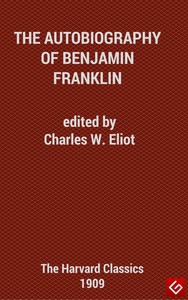
The Autobiography of Benjamin Franklin by Benjamin Franklin

(6 User reviews)   3603
Franklin, Benjamin, 1706-1790 Franklin, Benjamin, 1706-1790
English
Ever wonder how one of America's founding figures went from a teenage runaway to a world-famous inventor and diplomat? Benjamin Franklin's autobiography isn't just a dry history lesson—it's the ultimate self-improvement story, told by the man himself. He doesn't hide his mistakes, sharing his wild youth, early business failures, and his famous list of 13 virtues he tried (and often failed) to master. The real mystery is how someone so famously practical and witty viewed his own incredible life. It’s like getting coffee with one of history's smartest minds.
Share

Read "The Autobiography of Benjamin Franklin by Benjamin Franklin" Online

This book is available in the public domain. Start reading the digital edition below.

START READING FULL BOOK
Instant Access    Mobile Friendly

Book Preview

A short preview of the book’s content is shown below to give you an idea of its style and themes.

Benjamin Franklin was born in Milk Street, Boston, on January 6, 1706. His father, Josiah Franklin, was a tallow chandler who married twice, and of his seventeen children Benjamin was the youngest son. His schooling ended at ten, and at twelve he was bound apprentice to his brother James, a printer, who published the "New England Courant." To this journal he became a contributor, and later was for a time its nominal editor. But the brothers quarreled, and Benjamin ran away, going first to New York, and thence to Philadelphia, where he arrived in October, 1723. He soon obtained work as a printer, but after a few months he was induced by Governor Keith to go to London, where, finding Keith's promises empty, he again worked as a compositor till he was brought back to Philadelphia by a merchant named Denman, who gave him a position in his business. On Denman's death he returned to his former trade, and shortly set up a printing house of his own from which he published "The Pennsylvania Gazette," to which he contributed many essays, and which he made a medium for agitating a variety of local reforms. In 1732 he began to issue his famous "Poor Richard's Almanac" for the enrichment of which he borrowed or composed those pithy utterances of worldly wisdom which are the basis of a large part of his popular reputation. In 1758, the year in which he ceased writing for the Almanac, he printed in it "Father Abraham's Sermon," now regarded as the most famous piece of literature produced in Colonial America. Meantime Franklin was concerning himself more and more with public affairs. He set forth a scheme for an Academy, which was taken up later and finally developed into the University of Pennsylvania; and he founded an "American Philosophical Society" for the purpose of enabling scientific men to communicate their discoveries to one another. He himself had already begun his electrical researches, which, with other scientific inquiries, he carried on in the intervals of money-making and politics to the end of his life. In 1748 he sold his business in order to get leisure for study, having now acquired comparative wealth; and in a few years he had made discoveries that gave him a reputation with the learned throughout Europe. In politics he proved very able both as an administrator and as a controversialist; but his record as an office-holder is stained by the use he made of his position to advance his relatives. His most notable service in home politics was his reform of the postal system; but his fame as a statesman rests chiefly on his services in connection with the relations of the Colonies with Great Britain, and later with France. In 1757 he was sent to England to protest against the influence of the Penns in the government of the colony, and for five years he remained there, striving to enlighten the people and the ministry of England as to Colonial conditions. On his return to America he played an honorable part in the Paxton affair, through which he lost his seat in the Assembly; but in 1764 he was again despatched to England as agent for the colony, this time to petition the King to resume the government from the hands of the proprietors. In London he actively opposed the proposed Stamp Act, but lost the credit for this and much of his popularity through his securing for a friend the office of stamp agent in America. Even his effective work in helping to obtain the repeal of the act left him...

This is a limited preview. Download the book to read the full content.

This is the story of Benjamin Franklin, in his own words. It starts with his childhood in Boston, his apprenticeship to his brother, and his bold decision to run away to Philadelphia at 17 with just a few coins in his pocket. We follow his rise as a printer, the creation of his famous Poor Richard's Almanack, and his groundbreaking experiments with electricity. The book trails off before the American Revolution, focusing instead on his personal journey of building a life, a fortune, and a reputation from nothing.

Why You Should Read It

Forget the statue of the old man with the kite. This book shows you the ambitious, funny, and sometimes frustratingly honest young Franklin. His voice is conversational and disarmingly direct. You'll get his clever system for self-betterment (including his chart for tracking his 13 virtues), his blunt business advice, and his witty observations on human nature. It’s less about grand historical events and more about the daily grind of building character and success. You see the man behind the myth, flaws and all.

Final Verdict

Perfect for anyone curious about the roots of the American mindset, fans of memoirs, or people who love a good rags-to-respectability story. It's surprisingly relatable—Franklin's struggles with pride, his money troubles, and his desire to be a better person feel very modern. If you want a human connection to history, told with charm and practical wisdom, this is your book.


🔖 Free to Use

Legal analysis indicates this work is in the public domain. Use this text in your own projects freely.

Barbara Wilson
8 months ago

After finishing this book, the author's voice is distinct and makes complex topics easy to digest. I couldn't put it down.

5
5 out of 5 (6 User reviews )

Add a Review

Your Rating *
There are no comments for this eBook.
You must log in to post a comment.
Log in


Related eBooks