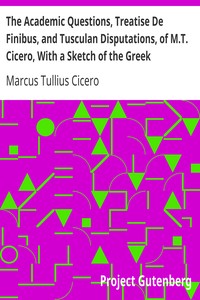
The Academic Questions, Treatise De Finibus, and Tusculan Disputations, of M.T.…

(2 User reviews)   3233
Cicero, Marcus Tullius, 107 BCE-44 BCE Cicero, Marcus Tullius, 107 BCE-44 BCE
English
Ever wonder what kept ancient Rome's greatest thinkers up at night? Forget gladiators and emperors for a moment. This book is your backstage pass to the intellectual after-parties of the 1st century BCE. Cicero, Rome's rockstar lawyer and philosopher, gathers his friends and just... talks. They argue about the meaning of happiness, whether the soul is immortal, and how to face fear and grief. There are no easy answers, just brilliant minds wrestling with the same big questions that still haunt us today. It’s surprisingly raw, deeply personal, and feels less like dusty philosophy and more like eavesdropping on the most fascinating conversation you'll ever hear.
Share

Read "The Academic Questions, Treatise De Finibus, and Tusculan Disputations, of M.T.…" Online

This book is available in the public domain. Start reading the digital edition below.

START READING FULL BOOK
Instant Access    Mobile Friendly

Book Preview

A short preview of the book’s content is shown below to give you an idea of its style and themes.

the main points in which they agreed with, or differed from, each other. The earliest of them was _Thales_, who was born at Miletus, about 640 B.C. He was a man of great political sagacity and influence; but we have to consider him here as the earliest philosopher who appears to have been convinced of the necessity of scientific proof of whatever was put forward to be believed, and as the originator of mathematics and geometry. He was also a great astronomer; for we read in Herodotus (i. 74) that he predicted the eclipse of the sun which happened in the reign of Alyattes, king of Lydia, B.C. 609. He asserted that water is the origin of all things; that everything is produced out of it, and everything is resolved into it. He also asserted that it is the soul which originates all motion, so much so, that he attributes a soul to the magnet. Aristotle also represents him as saying that everything is full of Gods. He does not appear to have left any written treatises behind him: we are uncertain when or where he died, but he is said to have lived to a great age—to 78, or, according to some writers, to 90 years of age. _Anaximander_, a countryman of Thales, was also born at Miletus, about 30 years later; he is said to have been a pupil of the former, and deserves especial mention as the oldest philosophical writer among the Greeks. He did not devote himself to the mathematical studies of Thales, but rather to speculations concerning the generation and origin of the world; as to which his opinions are involved in some obscurity. He appears, however, to have considered that all things were formed of a sort of matter, which he called τὸ ἄπειρον, or The Infinite; which was something everlasting and divine, though not invested with any spiritual or intelligent nature. His own works have not come down to us; but, according to Aristotle, he considered this “Infinite” as consisting of a mixture of simple, unchangeable elements, from which all things were produced by the concurrence of homogeneous particles already existing in it,—a process which he attributed to the constant conflict between heat and cold, and to affinities of the particles: in this he was opposed to the doctrine of Thales, Anaximenes, and Diogenes of Apollonia, who agreed in deriving all things from a single, not _changeable_, principle. Anaximander further held that the earth was of a cylindrical form, suspended in the middle of the universe, and surrounded by water, air, and fire, like the coats of an onion; but that the interior stratum of fire was broken up and collected into masses, from which originated the sun, moon, and stars; which he thought were carried round by the three spheres in which they were respectively fixed. He believed that the moon had a light of her own, not a borrowed light; that she was nineteen times as large as the earth, and the sun twenty-eight. He thought that all animals, including man, were originally produced in water, and proceeded gradually to become land animals. According to Diogenes Laertius, he was the inventor of the gnomon, and of geographical maps; at all events, he was the first person who introduced the use of the gnomon into Greece. He died about 547 B.C. _Anaximenes_ was also a Milesian, and a contemporary of Thales and Anaximander. We do not exactly know when he was born, or when he died; but he must have lived to a very great age, for he was in high repute...

This is a limited preview. Download the book to read the full content.

This isn't a novel with a traditional plot. Think of it as a series of intense, recorded conversations. In The Academic Questions, Cicero debates whether we can truly know anything for certain. On Ends (De Finibus) is a marathon debate on the ultimate goal of life—is it pleasure, virtue, or something else? Finally, the Tusculan Disputations are like ancient therapy sessions, tackling how to conquer the fear of death and manage emotional pain.

Why You Should Read It

What blew me away was how modern Cicero feels. He’s not preaching from an ivory tower; he’s a stressed-out politician trying to find peace in a collapsing republic. His writing on grief after his daughter's death is heartbreakingly real. You see a brilliant man using philosophy as a tool to survive, not just to lecture. It makes these huge ideas about happiness and mortality feel urgent and personal.

Final Verdict

This is for the curious reader, not just the classics student. If you’ve ever enjoyed a deep, meandering conversation about life’s big picture, you’ll find a kindred spirit in Cicero. It’s perfect for anyone who likes philosophy but hates stuffy textbooks, or for historical fiction fans who want to hear the real voices behind the togas. Be prepared to pause and think—a lot. It’s a challenging but incredibly rewarding brain-date with one of history’s greatest minds.


🟢 Public Domain Notice

No rights are reserved for this publication. Knowledge should be free and accessible.

Kimberly Hill
9 months ago

I started reading out of curiosity and it creates a vivid world that you simply do not want to leave. Absolutely essential reading.

Joseph Smith
6 months ago

To be perfectly clear, the plot twists are genuinely surprising. Worth every second.
5
5 out of 5 (2 User reviews )

Add a Review

Your Rating *
There are no comments for this eBook.
You must log in to post a comment.
Log in


Related eBooks