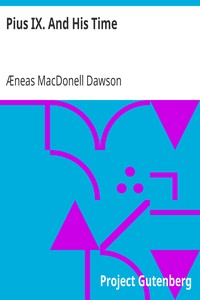
Pius IX. And His Time by Æneas MacDonell Dawson

(4 User reviews)   2258
By Charlotte Girard Posted on Nov 15, 2025
In Category - Philosophy
Dawson, Æneas MacDonell, 1810-1894 Dawson, Æneas MacDonell, 1810-1894
English
Ever wonder what it was like to be the pope who ruled longer than any other, right as the modern world was exploding? This biography of Pius IX isn't a dry history lesson. It's a front-row seat to a collision of faith and revolution. The author, writing just after the pope's death, gives us a fiercely partisan but utterly fascinating look at a man caught between ancient tradition and the rising forces of nationalism and secularism. You won't get a balanced view here—you'll get a passionate defense from someone who was there. It's like reading history written in real-time, with all the bias and conviction that comes with it. If you want to understand the 19th-century Catholic Church's fight for survival, start with this charged and personal account.
Share

Read "Pius IX. And His Time by Æneas MacDonell Dawson" Online

This book is available in the public domain. Start reading the digital edition below.

START READING FULL BOOK
Instant Access    Mobile Friendly

Book Preview

A short preview of the book’s content is shown below to give you an idea of its style and themes.

member of the Noble Guard. This the delicate state of his health forbade. Repelled by the Prince Commandant, he sought counsel of the Pope. Pius VII. pronounced that his destiny was the Cross, and advised him to devote himself to the ecclesiastical state. The words of the Holy Father were, to the youthful Mastai, as a voice from on high. He decided for the Church, and, as if in testimony that his decision was ratified in heaven, the falling-sickness left him. His studies were more than ordinarily successful, and he already gave proof of those high qualities which were afterwards so greatly developed. The distinguished Canon Graniare, his professor, little dreaming of the exalted destiny which awaited him, held him up as a pattern of excellence to his fellow-students, saying that he possessed the heart of a Pope. Whilst yet a student, Mastai interested himself in an orphanage, which was founded by John Bonghi, a charitable mason of Rome. He spent in this institution the first seven years of his priesthood, devoting himself to the care of the orphans, who were, as yet, his only parishioners. The income which he derived from family resources was liberally applied in supplying the wants of these destitute children, and even in ministering to their recreation. It now became his duty to accompany, as a missionary priest, Monsignore Mazi, who was appointed Vicar-Apostolic for Chili, Peru and Mexico. These countries had thrown off the yoke of Spain and adopted Republican forms of government. The Vicar-Apostolic and his companions suffered much in the course of their voyage to America. They were cast into prison, at the Island of Majorca, by Spanish officials, who took it amiss that Rome should hold direct relations with the rebellious subjects of their government. Their ship was attacked by corsairs, and was afterwards in danger from a storm. A single circumstance only need be mentioned in order to show what the faithful ministers of the Church had to endure when traversing the inhospitable steppes of the Pampas. Once, at night, they had no other shelter than a wretched cabin built with the bones of animals, which still emitted a cadaverous odour. In those arid deserts, they suffered from thirst as well as from dearth of provisions. Great results can only be attained by equally great labors. If, after a period of privation, the travellers enjoyed no more luxurious refreshment than the waters of the crystal brook, it might well be said, “de torrente in viabibet propterea exaltabit caput.” (They shall be reduced to quench their thirst in the mountain stream, and therefore shall be exalted.) The delegates of the Holy Father were received with enthusiasm by the South American populations. Meanwhile, the narrow governments that were set over those countries raised so many difficulties that the mission was only partially successful. This mission, however, was not without benefit to the Reverend Count Mastai. It had been the means of developing the admirable qualities which he possessed. It had afforded him the opportunity of seeing many cities, as well as the manners and customs of many people. These lessons of travel were not addressed to an ordinary mind. His views were enlarged, elevated and refined by contact with so many rising or fallen civilizations, so many different nationalities, and by the spectacle of Nature, that admirable handmaid of the Divinity, with her varied splendors and her manifold wonders, astonishing no less in the immensity of the ocean than in the vast forests of the New World. The mind appears to grow as the sphere of material life extends. Vast horizons are...

This is a limited preview. Download the book to read the full content.

Let's be clear from the start: this isn't an impartial, modern biography. Æneas MacDonell Dawson writes as a devoted Catholic contemporary, giving us a biography of Pope Pius IX that reads more like a spirited defense than a detached analysis. The book covers his entire, record-breaking pontificate from 1846 to 1878.

The Story

Dawson walks us through the massive upheavals of Pius IX's reign. We see a pope who starts as a hopeful reformer, cheered by crowds, only to be chased from Rome by revolution in 1848. The book follows his return, his dogmatic stand at the First Vatican Council (where papal infallibility was declared), and his final years as the 'Prisoner of the Vatican' after losing the Papal States to the new Italian nation. The central drama is Pius's lifelong struggle to uphold the Church's temporal and spiritual authority against what he saw as the destructive tides of liberalism and nationalism.

Why You Should Read It

The value here isn't in cold facts, but in raw perspective. Dawson doesn't hide his admiration. Reading him is like listening to a brilliant, one-sided argument from the 1890s. You feel the tension, the fear, and the absolute certainty of that era's Catholic worldview. It’s a primary source that lets you inside the mindset of a Church under siege, making later history make so much more sense.

Final Verdict

This is a perfect pick for readers who love primary sources and aren't afraid of a biased narrator. It's essential for understanding 19th-century Catholic history, but you have to read it with your eyes open. Pair it with a more critical modern biography for the full picture. Think of it as the passionate opening statement in a long historical debate.


📜 No Rights Reserved

This title is part of the public domain archive. Access is open to everyone around the world.

Mary Jackson
4 months ago

Honestly, the content flows smoothly from one chapter to the next. Worth every second.

Thomas Smith
1 year ago

I didn't expect much, but it creates a vivid world that you simply do not want to leave. Exceeded all my expectations.

Lisa White
1 year ago

From the very first page, the atmosphere created is totally immersive. Thanks for sharing this review.

Deborah Rodriguez
1 year ago

To be perfectly clear, the emotional weight of the story is balanced perfectly. Don't hesitate to start reading.


4
4 out of 5 (4 User reviews )

Add a Review

Your Rating *
There are no comments for this eBook.
You must log in to post a comment.
Log in


Related eBooks