1

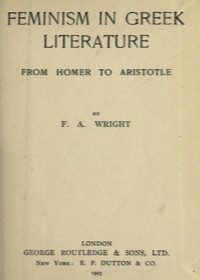
Feminism in Greek Literature from Homer to Aristotle — Background and Themes
(0 User reviews)
649
Project Gutenberg
2019
Not confirmed
Greek literature -- History and criticism; Women -- Greece -- History; Women in literature; Women and literature -- Greece; Feminism and literature -- Greece; Feminist literary criticism
Readers of public-domain and historical texts
Project Gutenberg digital edition
en
Edition facts
Words
55,532
Reading time
242 min
Text sections
7
Before opening Feminism in Greek Literature from Homer to Aristotle — Background and Themes, the edition data offers a quick orientation: 55,532 words, 4 hr 2 min estimated reading time, and 7 detected text sections.
The text analysis averages about 26.1 words per sentence, while the detected sections provide another way to judge how the source is divided.
Project Gutenberg metadata also associates the work with “Greek literature -- History and criticism,” connecting these edition facts with the source record’s subject description.
Source:
Project Gutenberg record #59205
F. A. Wright's 1923 study argues that Greek civilization declined due to the low status of women, tracing literary evidence from Homer to Aristotle. The book examines epic, lyric, dramatic, and philosophical texts, focusing on works by Euripides, Aristophanes, and Plato, with a polemical thesis that sex-war and misogyny pervaded Greek culture.
Read the complete public-domain text at its original source.
Read on Project GutenbergWright opens with a stark claim: Greek civilization fell because of 'a low ideal of womanhood and a degradation of women.' He frames the entire literary tradition as a battlefield, describing 'an almost open state of sex-war' in Ionia and Athens. The introduction sets a combative tone, asserting that men, not women, were in the wrong and that writers from Simonides to Juvenal used rhetoric to 'disparage and depreciate womankind.' This is not a neutral survey but a polemic, and readers should expect Wright to read texts as evidence in a cultural indictment.
The Prologue as a Clue to Wright's Method
In his analysis of Euripides' Ion, Wright juxtaposes the divine prologue with what he calls the 'real plot.' He dismisses the god Hermes' account as 'convention' and instead retells the story in blunt, modern terms: a young girl is 'attacked by a brutal satyr,' violated, and abandoned. Wright insists that Euripides 'knows as well as we do that gods do not walk the earth.' This move—stripping away mythological framing to expose a raw social reality—is central to his approach. He treats the prologue as a polite fiction and the play itself as a realistic depiction of sexual violence, illegitimacy, and female desperation. Readers should watch for this pattern: Wright consistently privileges the 'realistic' over the 'idealistic,' often rewriting plots to highlight women's suffering and men's hypocrisy.
Euripides' Women: Between Saint and Devil
Wright contrasts the Medea and Alcestis as 'one-part plays' centered on a strong woman and a weak man. He calls Alcestis 'a saint' and Medea 'to some people—a devil,' but immediately qualifies: Medea is 'not meant to be a pleasant character' because she has 'laboured too long under a sense of injustice.' Wright quotes Medea's famous line—'Of all things that draw breath'—to illustrate her 'revolt of women in its bitterest form.' He also reports Jason's retort: 'You are always abusing the government; and so you will have to be ejected.' This exchange, rendered in colloquial English, shows Wright's habit of translating ancient conflict into modern political terms. He does not pretend to neutrality; his sympathy lies with the women, and he reads the plays as documents of a sex-war in which men held the power.
The Milesian Tales and the Ionian Background
Wright devotes a chapter to the Milesian tales, a lost genre of erotic and often scandalous stories from Ionia. He argues that these tales reflect the social reality of Miletus, where 'a woman never sat at table with her husband, for he was the enemy with whom bread must not be broken.' This detail, drawn from historical sources, anchors his broader claim that Greek literature cannot be separated from Greek social practice. The tales themselves are fragmentary, but Wright uses them as evidence of a culture that segregated and degraded women. He treats literature as a symptom, not a cause, of the 'canker-spots' that doomed Athens and Greece. Readers should note that Wright's evidence is often circumstantial; he moves freely between literary texts and historical anecdotes, building a cumulative case rather than a strict philological argument.
Aristotle and the Philosophical Justification of Subordination
In the final chapter, Wright turns to Aristotle, whom he presents as the philosophical architect of female subordination. He cites Aristotle's doctrine that 'some people were slaves because'—the excerpt breaks off, but the context is clear: Aristotle provided a theoretical justification for hierarchy. Wright earlier linked the position of women and slaves as 'the two classes went together.' For him, Aristotle's biology and politics are not neutral science but ideological weapons. This section completes the arc from Homer to Aristotle, showing how Greek thought, from epic to philosophy, systematically excluded women from full humanity. Wright's reading is avowedly partisan; he does not attempt to balance Aristotle's views with counterexamples. The book ends with the implication that the literary tradition itself is complicit in the 'degradation' that caused Greece's fall.
Wright's book is best read as a sustained argument rather than a reference work. He selects texts that support his thesis and interprets them with a modern, often anachronistic, vocabulary. Readers unfamiliar with Greek literature may find his retellings vivid but should verify details against the originals. Those who know the plays may question his emphasis. Either way, the book offers a provocative lens: it forces us to ask how far literature reflects or reinforces social injustice, and whether a civilization's art can be judged by its treatment of women.
Reading Wright’s fierce little book, I kept thinking how strange it is that the loudest voices in Athens so rarely let women speak. That old ache lingers, and it sent me back to Greek Women — Key Ideas to Explore, which gentles the sorrow without smoothing it. Some arguments stay with you, like a particular dusk.
There are no reviews for this eBook.
There are no comments for this eBook.
Reader reflection
Take a moment to reflect on this book
Create a short personal record of your experience with this book.
Your progress
0
/
10
2
How did the book work for you overall?
3
Would you encourage someone else to read it?
4
How demanding did the text feel?
5
How distinctive were its ideas or approach?
6
Did it raise ideas you would like to talk about?
7
How much did the book move you?
8
Could you apply anything you learned?
9
What changed or sharpened your thinking?
10