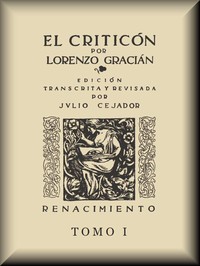
El criticón (tomo 1 de 2) by Baltasar Gracián y Morales

(4 User reviews)   3452
Gracián y Morales, Baltasar, 1601-1658 Gracián y Morales, Baltasar, 1601-1658
Spanish
Imagine a book that's part adventure, part philosophy lesson, and part 17th-century reality check. That's 'El criticón' by Baltasar Gracián. Think of it as a Spanish 'Pilgrim's Progress' but with way more biting social commentary. The story follows Critilo, a man shipwrecked on the island of St. Helena, who has to raise his son Andrenio completely isolated from civilization. The big question? What happens when this 'natural man' finally encounters the real, often hypocritical, world? It's a sharp, witty look at human nature that feels surprisingly fresh today.
Share

Read "El criticón (tomo 1 de 2) by Baltasar Gracián y Morales" Online

This book is available in the public domain. Start reading the digital edition below.

START READING FULL BOOK
Instant Access    Mobile Friendly

Book Preview

A short preview of the book’s content is shown below to give you an idea of its style and themes.

algo de la actual, normalizándola a la grafía de mayor frecuencia. * Se han añadido tildes a las mayúsculas que las necesitan. * Las páginas en blanco han sido eliminadas. * Las notas a pie de página han sido renumeradas. * Las notas al margen aparecen encerradas entre corchetes y presentadas como [Marginal:...] dentro del texto. [Ilustración] BIBLIOTECA RENACIMIENTO DIRIGIDA POR _G. MARTÍNEZ SIERRA_ COLECCIÓN DE OBRAS MAESTRAS DE LA LITERATURA UNIVERSAL [Ilustración] LA EDICIÓN Y COMENTARIO DE LOS TEXTOS CLÁSICOS ESPAÑOLES, LA TRADUCCIÓN DE LOS EXTRANJEROS Y LOS PRÓLOGOS DE UNOS Y OTROS ESTÁN Á CARGO DE EMINENTES ESCRITORES, CRÍTICOS Y ERUDITOS, LOS MÁS COMPETENTES EN LA MATERIA: _GABRIEL ALOMAR, AZORÍN, PÍO BAROJA, JACINTO BENAVENTE, BERNARDO G. DE CANDAMO, AMÉRICO CASTRO, JULIO CEJADOR, ENRIQUE DÍEZ-CANEDO, FERNANDO FORTÚN, RICARDO FUENTE, VICENTE GARCÍA DE DIEGO, J. GÓMEZ OCERÍN, FRANCISCO A. DE ICAZA, JUAN R. JIMÉNEZ, RICARDO LEÓN, EDUARDO MARQUINA, G. MARTÍNEZ SIERRA, FRANCISCO MEDINA, ENRIQUE DE MESA, ANTONIO PALOMERO, R. PÉREZ DE AYALA, JACINTO O. PICÓN, CIPRIANO RIVAS CHERIF, FRANCISCO RODRÍGUEZ MARÍN, VÍCTOR SAID-ARMESTO, EUGENIO SELLÉS, RAMÓN M. TENREIRO, MIGUEL DE UNAMUNO, FRANCISCO F. VILLEGAS. ETC., ETC._ LA PARTE ARTÍSTICA DE ESTAS EDICIONES ESTÁ ENCOMENDADA AL ILUSTRE DIBUJANTE _FERNANDO MARCO_. [Ilustración: RETRATO DEL P. BALTASAR GRACIÁN SACADO DEL LIENZO QUE PERTENECIÓ AL COLEGIO DE LOS PP. JESUÍTAS DE CALATAYUD _Y HOY ES PROPIEDAD DE D. FÉLIX SANZ DE LARREA_.] [Ilustración: BIBLIOTECA RENACIMIENTO OBRAS MAESTRAS DE LA LITERATURA UNIVERSAL] [Ilustración: EL CRITICÓN POR LORENZO GRACIÁN EDICIÓN TRANSCRITA Y REVISADA POR JVLIO CEJADOR RENACIMIENTO _Casa Central_: MADRID, _Pontejos 3_ SVCVRSALES: BVENOS AIRES, _Libertad 170_ PARÍS, _26, Rue Richelieu_] PRÓLOGO _El Padre Baltasar Gracián[1] y Morales nació en Belmonte, aldea de la ciudad de Calatayud, el 8 de Enero de 1601, de casa y familia infanzona. Tuvo por hermanos al P. Felipe Gracián, Clérigo Menor, Asistente de su Religión en Roma; al P. Fr. Pedro Gracián, Trinitario, que murió en la flor de su edad; al P. Fr. Raimundo Gracián, Carmelita Descalzo. Varones todos religiosos y literatos, como se ve en su_ Arte de Ingenio y Agudeza, _Disc. 20, 13, 32 y 53. En el 25 dice que él se crió en Toledo en casa de su tío el Licenciado Antonio Gracián. Enseñó en la Compañía de Jesús letras humanas, filosofía y teología con el crédito que puede suponerse._ [1] En la partida de bautismo se halla escrito _Galacián_, como todavía llama por Calatayud la gente del pueblo á la familia _Gracián_, que aún dura en la comarca. _Exacto religioso, celoso en los cargos de su profesión, grande orador, sabio filósofo, discreto, ingenioso y agudo sobre todo encarecimiento. Tan dulce y suave en el numen poético como en la ciencia y en la práctica del gobierno._ _Tuvo por íntimos amigos á Manuel de Salinas, á Francisco Andrés de Ustarroz, el Solitario, y al famoso anticuario oscense Vincencio Juan de Lastanosa, el cual, según testimonio de su hijo Vincencio Antonio[2], publicó en Huesca las obras de Gracián contra la voluntad de su autor._ [2] _Revista de Archivos_, t. VIII, 1877, p. 30. _Fué Rector del Colegio de Tarragona y murió en el de Tarazona el 6 de Diciembre de 1658, de edad de cincuenta y ocho años._ _Al pie del retrato del P. Gracián, que se hallaba en el claustro del Colegio de los PP. Jesuítas de Calatayud, y que hoy posee D. Félix Sanz de Larrea y reproducimos en esta edición, se lee:_ “_P. Balthasar Gracian ut iam ab ortu emineret in Bellomonte natus est prope Bilbilim, confinis Martiali patria, proximus ingenio, ut profunderet adhuc xristianas argutias Bilbilis, quae poene exhausta videbatur in aethnicis....

This is a limited preview. Download the book to read the full content.

Published in 1651, this is a classic of Spanish Golden Age literature that's more than just a period piece. Gracián wraps his deep thoughts on life in the story of two travelers.

The Story

The book kicks off with Critilo, a man of the world, stranded on a remote island. There, he discovers Andrenio, a young man who has grown up with zero human contact, raised by animals. Critilo becomes his guide, naming him and starting his education. The first part of their journey is about Andrenio learning everything from scratch—language, reason, and the basics of society. The real adventure, and the book's main thrust, begins when they leave the island. They set out into the wide world, which Gracián uses as a giant metaphor for life's journey, filled with all its deceptions, vices, and occasional virtues.

Why You Should Read It

Don't let the 1600s publication date scare you off. Gracián's observations are piercingly smart and often funny. Through Andrenio's innocent eyes, we see our own world's absurdities laid bare—the lies people tell, the masks they wear, the silly things we chase. It’s like having a brutally honest friend point out everything that's wrong with society, but with beautiful, polished prose. The relationship between the worldly teacher and the pure student is the heart of the book and makes the heavy themes easy to connect with.

Final Verdict

This is a perfect pick for readers who love classic literature with teeth, like Cervantes or Swift. If you enjoy stories where the journey is really about exploring big ideas—truth, deception, and what it means to live well—you'll find a lot here. Be ready for allegory and symbolism, not fast-paced action. It's a slow, thoughtful walk through a beautifully crafted, critical view of humanity that still holds up a mirror to us today.


🟢 Community Domain

This text is dedicated to the public domain. You are welcome to share this with anyone.

Sarah Martin
1 year ago

I didn't expect much, but the depth of research presented here is truly commendable. I will read more from this author.

Lucas Jackson
1 year ago

I came across this while browsing and the arguments are well-supported by credible references. Highly recommended.

Mary Anderson
3 months ago

I started reading out of curiosity and the storytelling feels authentic and emotionally grounded. Don't hesitate to start reading.

Sandra Wright
6 months ago

Surprisingly enough, the narrative structure is incredibly compelling. Definitely a 5-star read.
5
5 out of 5 (4 User reviews )

Add a Review

Your Rating *
There are no comments for this eBook.
You must log in to post a comment.
Log in


Related eBooks