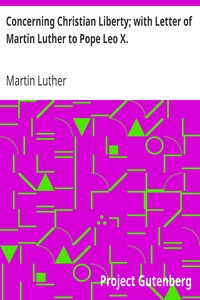
Concerning Christian Liberty; with Letter of Martin Luther to Pope Leo X. by Luther

(6 User reviews)   3585
Luther, Martin, 1483-1546 Luther, Martin, 1483-1546
English
Ever wonder what was in that famous letter Martin Luther sent to the Pope that kicked off the Reformation? It's not just a dry historical document. This book gives you the full text of Luther's explosive 'Letter to Pope Leo X,' paired with his powerful essay 'Concerning Christian Liberty.' It's the raw, unfiltered argument that shattered Western Christianity. Luther isn't just complaining about church corruption; he's making a radical claim about faith, freedom, and what it really means to be a Christian. The tension is incredible—you can feel the history bending as you read his bold, sometimes surprisingly respectful, challenge to the most powerful man in Europe.
Share

Read "Concerning Christian Liberty; with Letter of Martin Luther to Pope Leo X. by Luther" Online

This book is available in the public domain. Start reading the digital edition below.

START READING FULL BOOK
Instant Access    Mobile Friendly

Book Preview

A short preview of the book’s content is shown below to give you an idea of its style and themes.

stand the dirty business in Europe and the dirtier politicians at home. There was treachery in the Senate, treason in the House. A plague of liars infested the Republic; the land was rotting with plots. But if the authorities at Washington remained incredulous, stunned into impotency, while the din of murder filled the world, a few mere men, fed up on the mess, sickened while awaiting executive galvanization, and started east to purge their souls. They came from the four quarters of the continent, drawn to the decks of the mule transport by a common sickness and a common necessity. Only two among them had ever before met. They represented all sorts, classes, degrees of education and of ignorance, drawn to a common rendezvous by coincidental nausea incident to the temporary stupidity and poltroonery of those supposed to represent them in the Congress of the Great Republic. The rendezvous was a mule transport reeking with its cargo, still tied up to the sun-scorched wharf where scores of loungers loafed and gazed up at the rail and exchanged badinage with the supercargo. The supercargo consisted of this dozen-odd fed-up ones--eight Americans, three Frenchmen and one Belgian. There was a young soldier of fortune named Carfax, recently discharged from the Pennsylvania State Constabulary, who seemed to feel rather sure of a commission in the British service. Beside him, leaning on the blistering rail, stood a self-possessed young man named Harry Stent. He had been educated abroad; his means were ample; his time his own. He had shot all kinds of big game except a Hun, he told another young fellow--a civil engineer--who stood at his left and whose name was Jim Brown. A youth on crutches, passing along the deck behind them, lingered, listening to the conversation, slightly amused at Stent’s game list and his further ambition to bag a Boche. The young man’s lameness resulted from a trench acquaintance with the game which Stent desired to hunt. His regiment had been, and still was, the 2nd Foreign Legion. He was on his way back, now, to finish his convalescence in his old home in Finistère. He had been a writer of stories for children. His name was Jacques Wayland. As he turned away from the group at the rail, still amused, a man advancing aft spoke to him by name, and he recognized an American painter whom he had met in Brittany. "You, Neeland?" "Oh, yes. I’m fed up with watchful waiting." "Where are you bound, ultimately?" "I’ve a hint that an Overseas unit can use me. And you, Wayland?" "Going to my old home in Finistère where I’ll get well, I hope." "And then?" "Second Foreign." "Oh. Get that leg in the trenches?" inquired Neeland. "Yes. Came over to recuperate. But Finistère calls me. I’ve _got_ to smell the sea off Eryx before I can get well." A pleasant-faced, middle-aged man, who stood near, turned his head and cast a professionally appraising glance at the young fellow on crutches. His name was Vail; he was a physician. It did not seem to him that there was much chance for the lame man’s very rapid recovery. Three muleteers came on deck from below--all young men, all talking in loud, careless voices. They wore uniforms of khaki resembling the regular service uniform. They had no right to these uniforms. One of these young men had invented the costume. His name was Jack Burley. His two comrades were, respectively, "Sticky" Smith and "Kid" Glenn. Both had figured in the squared circle. All three were fed up. They desired to wallop something, even if...

This is a limited preview. Download the book to read the full content.

This isn't a novel, but the drama is real. In 1520, Martin Luther, a German monk, is in serious trouble with the Roman Catholic Church for his criticisms. Before things get even worse, he writes directly to Pope Leo X. This book lets you read that letter for yourself. Alongside it is his essay 'Concerning Christian Liberty,' which lays out his core idea: that salvation comes through faith in God's grace alone, not through rituals, good deeds, or buying indulgences from the church. He argues this faith actually makes a person truly free, while also binding them in love to serve their neighbor.

Why You Should Read It

Reading this is like getting a front-row seat to a world-changing moment. Luther's writing is direct, passionate, and surprisingly accessible. You get his famous 'paradox'—that a Christian is 'a perfectly free lord of all, subject to none' and yet 'a perfectly dutiful servant of all, subject to all.' It makes you think deeply about the meaning of freedom and duty, ideas that still matter today. Even if you're not religious, it's fascinating to witness the birth of a revolutionary idea that reshaped politics, culture, and individual thought.

Final Verdict

Perfect for anyone curious about how big ideas change the world. If you enjoy history, theology, or just powerful writing from a pivotal moment, this short book is worth your time. It's not an easy, relaxing read, but it's a profoundly impactful one. You won't just learn about history; you'll feel the earthquake Luther started, right from the source.


🟢 Open Access

This masterpiece is free from copyright limitations. Share knowledge freely with the world.
Jessica Gonzalez
1 year ago

As someone who reads a lot, the flow of the text seems very fluid. A true masterpiece.

4.5
4.5 out of 5 (6 User reviews )

Add a Review

Your Rating *
There are no comments for this eBook.
You must log in to post a comment.
Log in


Related eBooks