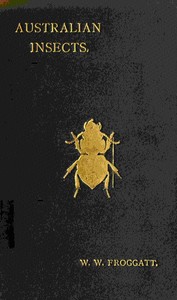
Australian insects by Walter W. Froggatt

(0 User reviews)   2292
Froggatt, Walter W. (Walter Wilson), 1858-1937 Froggatt, Walter W. (Walter Wilson), 1858-1937
English
Hey, I just finished this old book about Australian insects, and it's not what you'd expect. Written over a century ago by Walter Froggatt, it feels like stepping into a time machine. The science is fascinatingly out-of-date in places, and you can feel his genuine wonder for creatures most of us swat away. It's less a modern field guide and more a snapshot of a naturalist's mind at the dawn of Australian entomology. If you're curious about how we used to see the natural world, or just love weird historical science books, this is a quiet, charming little treasure.
Share

Read "Australian insects by Walter W. Froggatt" Online

This book is available in the public domain. Start reading the digital edition below.

START READING FULL BOOK
Instant Access    Mobile Friendly

Book Preview

A short preview of the book’s content is shown below to give you an idea of its style and themes.

Linnean Society of N.S. Wales, and N.S. Wales Naturalists’ Club. With 37 Plates, containing 270 Figures, also 180 text-blocks. [Illustration] Sydney: WILLIAM BROOKS & COMPANY, LIMITED, Printers and Publishers, 17 Castlereagh Street. PREFACE. There have been so many enquiries from people in all parts of Australia, as well as from visitors from other countries, for a book dealing with our insects, that the writer thinks that the time has come when a Text Book dealing exclusively with Australian Entomology will be well received, both at home and abroad, by all those interested in this subject. The difficulty has been to write in a popular style so as to interest the general reader, and induce him to further follow his studies of the wonders of Natural History, yet at the same time to define the characteristics of the insects described and give some idea of their classification, so that it will not lose its value as a Text Book to the student while enlarging the circle of its readers. Since the year 1770, when Sir Joseph Banks captured the first diamond beetle on the sandy shores of Botany Bay, the majority of our insects have been described in rare old English or foreign publications, the Zoology of Voyages and Travels, or the Transactions and Proceedings of Scientific Societies consisting of many hundreds of volumes written in many different languages. Many of these original descriptions, written in English or Latin, are so brief and obscure that without seeing the type they are quite unintelligible even to the trained entomologist, and therefore are absolutely of no value to the beginner. Most of the earlier describers of Australian insects confined their attention to beetles, moths, and butterflies. Among the few exceptions are Westwood, who has identified himself with insects in nearly all the orders, and as he figured many of them (often in colours), there is no trouble in determining his species; and Walker, who also described many unique Australian insects (chiefly in the British Museum Catalogues); but his often vague descriptions, without details or figures, have puzzled all entomologists who have not had access to his types. During the last decade, however, as specialists have taken up the work of monographing the more neglected orders, and as large general collections of insects have been obtained from what were, at one time, inaccessible parts of Australia, a writer can now obtain satisfactory data as to the classification and number of Australian insects hitherto wanting. With these views the present text book has been prepared. TABLE OF CONTENTS. PREFACE iii. CONTENTS vii. LIST OF PLATES xi. INTRODUCTION xiii. CLASSIFICATION 1 DISTRIBUTION 4 STRUCTURE 6 FOSSIL INSECTS 9 THE COLLECTION AND PRESERVATION OF INSECTS 395 MUSEUM COLLECTIONS AND TYPES 409 PUBLICATIONS DEALING WITH AUSTRALIAN ENTOMOLOGY 418 ADDENDA 423 INDEX 425 [Illustration: “The White Ant City,” Somerset, Cape York, N. Queensland. (After Savelle-Kent)] CONTENTS. Order I.--APTERA. Page Family 1. COLLEMBOLA 10 „ 2. THYSANURA 11 Order II.--ORTHOPTERA. Family 1. FORFICULIDAE 15 „ 2. BLATTIDAE 17 „ 3. TERMITIDAE 20 „ 4. EMBIIDAE 28 „ 5. PSOCIDAE 30 „ 6. MANTIDAE 31 „ 7. PHASMIDAE 34 „ 8. ACRIDIIDAE 40 „ 9. LOCUSTIDAE 46 „ 10. GRYLLIDAE 48 Order III.--NEUROPTERA. Family 1. PERLIDAE 50 „ 2. ODONATA 51 „ 3. EPHEMERIDAE 54 „ 4. SIALIDAE 55 „ 5. PANORPIDAE 56 „ 6. HEMEROBIIDAE 57 „ 7. TRICHOPTERA 66 Order IV.--HYMENOPTERA. Family 1. CEPHIDAE 70 „ 2. ORYSSIDAE 70 „ 3. SIRICIDAE 71 „ 4. TENTHREDINIDAE 71 „ 5. CYNIPIDAE 73 „ 6. CHALCIDIDAE 74 „ 7. PROCTOTRYPIDAE 81 „ 8. ICHNEUMONIDAE 83 „ 9. BRACONIDAE 85 „ 10....

This is a limited preview. Download the book to read the full content.

Walter Froggatt's Australian Insects isn't a novel with a plot, but its story is the story of discovery itself. Published in 1907, it catalogues the six-legged life of a continent through the eyes of a pioneering entomologist. Froggatt describes beetles, butterflies, ants, and 'stingers' with the meticulous care of a scientist, but also with the plain-spoken awe of a man who truly loved his subject. The 'story' here is the unfolding of a hidden world right underfoot, told with the knowledge and occasional assumptions of his time.

Why You Should Read It

You read this for the voice. Froggatt writes clearly, almost conversationally, about things he finds utterly compelling. There's a humble passion in his descriptions that modern textbooks often lack. It's also a fascinating historical artifact. You'll see how scientific understanding has shifted—some of his explanations for insect behavior are charmingly quaint by today's standards. Reading it feels like sitting on a veranda with a knowledgeable, slightly old-fashioned uncle who can't wait to tell you about the incredible moth he just found.

Final Verdict

This book is perfect for history of science nerds, amateur naturalists with a soft spot for vintage writing, or anyone who enjoys primary sources. It's not a practical bug-spotting guide for your next hike, but it is a warm, thoughtful window into the early days of Australian natural history. If you like the idea of a slow, descriptive walk through a bygone scientific landscape, you'll find Froggatt a wonderfully patient guide.


📢 Free to Use

Legal analysis indicates this work is in the public domain. Preserving history for future generations.

There are no reviews for this eBook.

0
0 out of 5 (0 User reviews )

Add a Review

Your Rating *
There are no comments for this eBook.
You must log in to post a comment.
Log in


Related eBooks