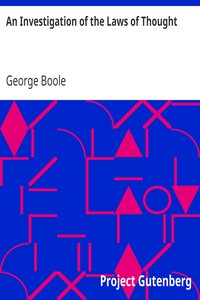
An Investigation of the Laws of Thought by George Boole
Read "An Investigation of the Laws of Thought by George Boole" Online
This book is available in the public domain. Start reading the digital edition below.
START READING FULL BOOKBook Preview
A short preview of the book’s content is shown below to give you an idea of its style and themes.
Let's be clear from the start: this isn't a novel. There's no plot twist or love story. Instead, George Boole presents an argument. He asks a huge question: Can the process of human reasoning, the way we combine ideas and draw conclusions, be expressed with the certainty of mathematics? The 'story' is his step-by-step construction of a new kind of algebra—one where symbols (like x and y) don't stand for numbers, but for classes of things or logical propositions. He shows how operations like 'AND', 'OR', and 'NOT' can be handled with equations. The climax isn't an event, but a realization: complex human thought can be modeled, simplified, and mechanized.
Why You Should Read It
It's humbling and mind-expanding. Boole writes with a calm, relentless logic that feels like watching a master craftsman at work. You see the raw, foundational code of our world being written. Every time you use a search engine ("cats AND dogs but NOT fish") or understand how a computer chip makes a decision, you're seeing Boole's ideas in action. Reading the original is different from just hearing about 'Boolean logic'—you get the sense of discovery, the elegant simplicity of his system emerging from pure thought.
Final Verdict
This is for the curious non-specialist who loves ideas. It's perfect if you're fascinated by the history of science, the philosophy of mind, or the hidden foundations of our digital lives. It requires some patience—it's a 19th-century scientific text—but the payoff is profound. You won't get car chases, but you might get the thrill of seeing the world in a completely new way. Think of it as the ultimate origin story for the age of information.
This title is part of the public domain archive. Thank you for supporting open literature.