An Architect's Note-Book in Spain by Sir M. Digby Wyatt

(0 User reviews)   1947
Wyatt, M. Digby (Matthew Digby), Sir, 1820-1877 Wyatt, M. Digby (Matthew Digby), Sir, 1820-1877
English
Forget your typical travel guide. Imagine following a top Victorian architect through Spain, not as a tourist, but as a detective. Sir M. Digby Wyatt's 'An Architect's Note-Book' is his raw, personal investigation. He's not just looking at buildings; he's trying to crack the code of Spanish design, from Moorish palaces to Gothic cathedrals. The real mystery? How did all these different styles come together to create something uniquely Spanish? It's like getting a backstage pass to the mind of a brilliant observer, filled with sketches and urgent notes that feel like they were written yesterday. If you love architecture, history, or just a great adventure seen through sharp eyes, this is your book.
Share

Read "An Architect's Note-Book in Spain by Sir M. Digby Wyatt" Online

This book is available in the public domain. Start reading the digital edition below.

START READING FULL BOOK
Instant Access    Mobile Friendly

Book Preview

A short preview of the book’s content is shown below to give you an idea of its style and themes.

of the stories, however, were probably in existence before this time. The Danish historian Saxo Grammaticus (c. 1200) was familiar with many of them, including the story of Hethin and Hˆgni[1] and one of the scenes recorded in _Hervarar Saga_[2]. And we are told that a story which seems to have corresponded, in its main outlines at least, to the story of Hromund Greipsson was composed and recited at a wedding in Iceland in 1119[3]. But in many cases the materials of our stories were far earlier than this, though they no doubt underwent considerable changes before they assumed their present form. Indeed many stages in the literary history of the North are represented in the following translations. Of these probably the oldest is that section of the _Hervarar Saga_ which deals with the battle between the Goths and the Huns "at Dylgia and on Dunheith and upon all the heights of Jˆsur." The poetry here included in the saga dates even in its present form probably from the Viking Age, perhaps from the tenth century. But the verses themselves do not appear to be all of the same date. Some of them show a certain elaboration and a sense of conscious art, while others are comparatively bare and primitive in type and contain very early features[4]; and there is every probability that such poetry was ultimately derived from poetry composed at a time when the Goths were still remembered. This is not surprising in view of the fact that stories relating to the Goths were popular in English and German heroic poetry, as well as in the heroic lays of the North. Indeed we know from Jordanes[5] and elsewhere that heroic poetry was common among the Goths themselves and that they were wont to celebrate the deeds of their ancestors in verse sung to the accompaniment of the harp. This poem is no doubt much older than the saga. Originally it would seem to have been complete in itself; but many verses have probably been lost. Thus there can be little doubt that the prose passages in chs. XII-XV are often merely a paraphrase of lost verses, though it must not be assumed that all the prose in this portion of the saga originated in such a way[6]. "It is difficult to tell ... where the prose of the manuscripts is to be taken as standing in the place of lost narrative verses, and where it fills a gap that was never intended to be filled with verse, but was always left to the reciter to be supplied in his own way[7]." The difficulty, however, is greater in some cases than in others. The following picturesque passage from the opening of ch. 14 of the _Hervarar Saga_ is a very probable instance of a paraphrase of lost verses: It happened one morning at sunrise that as Hervˆr was standing on the summit of a tower over the gate of the fortress, she looked southwards towards the forest and saw clouds of dust, arising from a great body of horse, by which the sun was hidden for a long time. Next she saw a gleam beneath the dust, as though she were gazing on a mass of gold--fair shields overlaid with gold, gilded helmets and white corslets. The motif of a chief or his lady standing on the pinnacle of a tower of the fort and looking out over the surrounding country for an approaching army is a very common one in ballads. The motif of the above passage from _Hervarar Saga_, including the armour of the foe and the...

This is a limited preview. Download the book to read the full content.

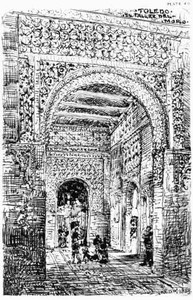
This isn't a novel with a plot, but it has all the energy of a great discovery. 'An Architect's Note-Book in Spain' is Wyatt's travel diary from the 1870s. He journeyed across Spain, sketchbook in hand, documenting everything from grand cathedrals in Toledo to quiet village details most people would miss. The 'story' is his quest to understand the country's architectural soul by looking directly at its buildings, drawing them, and writing down his immediate thoughts.

Why You Should Read It

What makes this special is Wyatt's voice. He's passionate and opinionated. You can feel his excitement when he finds a perfect arch, and his frustration when a beautiful building is poorly maintained. He doesn't give dry lectures; he shows you what he sees and explains why it matters. The book is filled with his own sketches, making you feel like you're peering over his shoulder. It turns architecture from a subject into a lived experience.

Final Verdict

Perfect for history buffs, art lovers, or anyone who enjoys smart travel writing. If you've ever wandered through an old city and wondered, 'How did they build that?' or 'What's the story here?'—Wyatt is the brilliant, enthusiastic friend you wish you had along to explain it all. It’s a timeless look at Spain through the eyes of someone who truly knew how to see.


🔖 Legal Disclaimer

Legal analysis indicates this work is in the public domain. You do not need permission to reproduce this work.


There are no reviews for this eBook.

0
0 out of 5 (0 User reviews )

Add a Review

Your Rating *
There are no comments for this eBook.
You must log in to post a comment.
Log in


Related eBooks